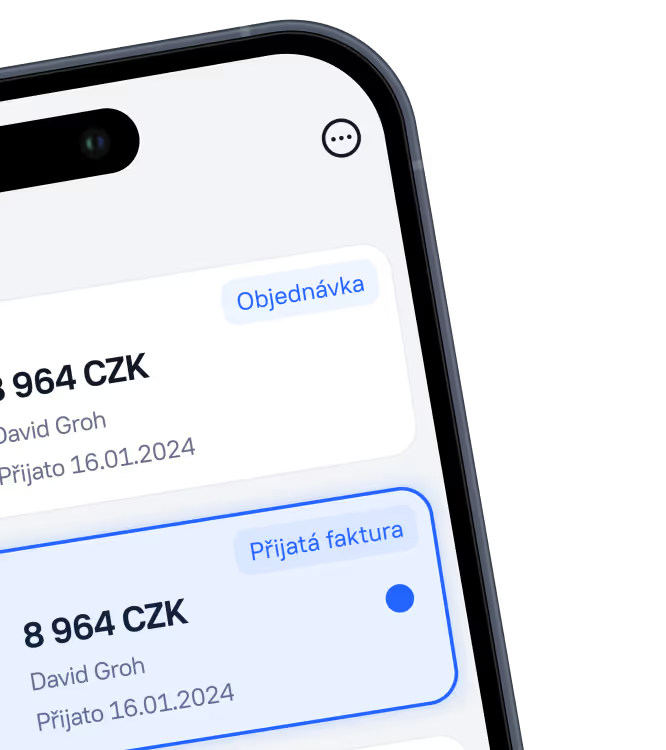


Manually re-entering invoice data is not only outdated, but also costly and inefficient. Automated invoice processing saves time, reduces errors and accelerates payments. This guide explains how invoice automation software improves cash flow and financial operations—and why it is becoming essential for modern finance teams.
- What invoice automation is and how it works
- The main benefits of automated invoice processing
- Essential features of modern invoice automation tools
- How to implement automated invoice processing
- Requirements for different types of businesses
- Common obstacles and how to overcome them
What Is Invoice Automation?
Definition and Core Technology
Invoice automation means using software to process incoming and outgoing invoices automatically—from receiving the document and extracting its data to approval and posting.
The objective is to eliminate manual data entry and connect the individual stages of invoice processing into one controlled digital workflow.
How Automated Invoice Processing Works
Invoice automation software typically uses:
- OCR (optical character recognition) to read invoices and accounting documents.
- AI (artificial intelligence) to extract and automatically validate invoice data.
The system identifies key information, compares it with purchase orders and prepares the document for approval.
Automated Invoice Processing vs. Manual Processing
Benefits of Invoice Automation Software
Elimination of Manual Data Entry
Automated invoice processing significantly reduces the volume of manual work and data entry. This also lowers the administrative costs of finance and accounting teams.
Fewer Errors and Fraudulent Invoices
Automated data validation and approval workflows minimise the risk of errors, duplicate invoices and fraudulent documents.
Faster Payments and Better Cash Flow
Automation makes it possible to approve invoices within minutes. This shortens payment cycles and improves relationships with suppliers.
Better Visibility and Real-Time Reporting
Finance teams can see the status of every invoice in real time, making expense planning and financial control significantly easier.
Key Features of Modern Invoice Automation Software
AI-Powered Invoice Data Extraction
Modern software can automatically recognise and extract information from different invoice and document formats without requiring manual data entry.
Three-Way Matching
An accounting digitalisation platform such as Wflow automatically compares data from the invoice, purchase order and goods receipt.
When the system identifies a discrepancy, it flags it immediately for review.
Automated Approval Workflows
Flexible approval rules and notifications can be configured for different roles and responsibilities. Invoices can be approved in real time, including through a mobile application.
ERP and Accounting Software Integration
Integration with accounting software, ERP platforms and other business systems eliminates repeated data entry and reduces the risk of errors.
Companies can modernise invoice processing without replacing the accounting or ERP systems they already use.
Exception Alerts and Notifications
Reliable invoice automation software automatically alerts users to errors, discrepancies and missing information.
.avif)
How to Get Started With Automated Invoice Extraction and Processing
Assess Invoice Volume and Process Weaknesses
Map your current process:
- How many invoices pass through your company each month?
- Where do the biggest approval delays occur?
- At which stage do errors most often appear?
Understanding the current workflow helps identify where automation can create the greatest value.
Choose the Right Platform
Compare available solutions based on:
- features,
- integrations,
- implementation requirements,
- and vendor support.
The right platform should fit your existing finance environment rather than force the company to rebuild it.
Configure Workflows and Rules
Define approval processes and set automation rules according to your organisation’s structure.
This may include:
- approval limits,
- role-based permissions,
- escalation rules,
- cost centres,
- and specific workflows for different document types.
Train Teams and Suppliers
Explain the new process clearly to internal users and external partners.
Successful implementation depends not only on the software itself, but also on whether people understand how documents should enter and move through the new workflow.
Measure the Benefits
Regularly evaluate:
- time savings,
- faster approvals,
- fewer errors,
- and shorter payment cycles.
Process configuration is largely a one-time investment, while the efficiency gains continue to grow over time.
How Automated Invoice Processing Works in Different Types of Businesses
Solutions for Small and Medium-Sized Businesses
Companies with fewer employees usually prefer tools that are easy to implement and affordable in terms of both time and cost.
A key requirement is integration with the accounting or ERP system the company already uses.
This allows SMEs to automate invoice processing without replacing a familiar and proven financial system.
Enterprise Solutions
More complex organisations require advanced workflows and greater process customisation.
Automated invoice processing can save dozens of hours each month and provide full control over financial operations.
Processes become faster, while finance teams can focus on more complex tasks that directly contribute to a financially healthier company.
Industry-Specific Requirements
Retail, manufacturing, professional services and accounting firms all have different requirements for:
- approvals,
- reporting,
- integrations,
- and document handling.
Wflow is used by companies across all of these industries.
Explore our customer case studies.
Common Obstacles to Efficient Finance Workflows
Inconsistent Invoice Formats
Working with different invoice and document formats takes time—and sometimes strong glasses.
Modern OCR technology can process different templates and non-standard documents without difficulty.
Delayed Supplier Payments
A heavy workload in the accounting team often leads to payment delays.
Invoice automation software helps prevent these delays by moving documents through validation and approval more efficiently.
It is worth communicating the benefits of automation to suppliers as well.
Faster payments and fewer errors can become a competitive advantage in supplier relationships.
Integration With Legacy Systems
Look for a solution with an open API and proven experience in system integration and data migration.
Wflow integrates with a wide range of established accounting and ERP systems, helping companies introduce a new workflow without unnecessary disruption.
FAQ
What Is Invoice Automation?
Invoice automation is the process of using software to handle incoming and outgoing invoices without manual data entry.
How Does Invoice Automation Software Work?
It uses OCR, AI and automated workflows to extract, validate and approve invoice data.
How Much Does Automated Invoice Processing Cost?
Pricing depends on invoice volume, required features and the licensing model. Most solutions are offered as a monthly subscription.
Can Invoice Automation Be Integrated With Our ERP?
Yes. Most modern invoice automation platforms integrate with ERP and accounting software.
What ROI Can We Expect From Invoice Automation?
The return depends on your invoice volume, current processing costs and the amount of manual work involved.
Contact the Wflow team to calculate the potential ROI based on your actual data. According to Stripe, automation costs can represent roughly one-third of the cost of manual processing. (Source: Stripe.com)
Sources
- J. P. Morgan: What is accounts payable automation?
- Stampli.com: 50+ accounts payable statistics about AI, automation, & more
- Parseur.com: Global Trends In AI Invoice Processing - Adoption Rates, Costs, And Challenges
- Deloitte : E-Invoicing: A catalyst for finance transformation and compliance
A Complete Guide to Automated Invoice Processing: Invoice Data Extraction Without Manual Work

.avif)
You will learn which features to look for, what to consider when selecting a solution and how automation transforms the daily work of accountants and CFOs.
Manually re-entering invoice data is not only outdated, but also costly and inefficient. Automated invoice processing saves time, reduces errors and accelerates payments. This guide explains how invoice automation software improves cash flow and financial operations—and why it is becoming essential for modern finance teams.
- What invoice automation is and how it works
- The main benefits of automated invoice processing
- Essential features of modern invoice automation tools
- How to implement automated invoice processing
- Requirements for different types of businesses
- Common obstacles and how to overcome them
What Is Invoice Automation?
Definition and Core Technology
Invoice automation means using software to process incoming and outgoing invoices automatically—from receiving the document and extracting its data to approval and posting.
The objective is to eliminate manual data entry and connect the individual stages of invoice processing into one controlled digital workflow.
How Automated Invoice Processing Works
Invoice automation software typically uses:
- OCR (optical character recognition) to read invoices and accounting documents.
- AI (artificial intelligence) to extract and automatically validate invoice data.
The system identifies key information, compares it with purchase orders and prepares the document for approval.
Automated Invoice Processing vs. Manual Processing
Benefits of Invoice Automation Software
Elimination of Manual Data Entry
Automated invoice processing significantly reduces the volume of manual work and data entry. This also lowers the administrative costs of finance and accounting teams.
Fewer Errors and Fraudulent Invoices
Automated data validation and approval workflows minimise the risk of errors, duplicate invoices and fraudulent documents.
Faster Payments and Better Cash Flow
Automation makes it possible to approve invoices within minutes. This shortens payment cycles and improves relationships with suppliers.
Better Visibility and Real-Time Reporting
Finance teams can see the status of every invoice in real time, making expense planning and financial control significantly easier.
Key Features of Modern Invoice Automation Software
AI-Powered Invoice Data Extraction
Modern software can automatically recognise and extract information from different invoice and document formats without requiring manual data entry.
Three-Way Matching
An accounting digitalisation platform such as Wflow automatically compares data from the invoice, purchase order and goods receipt.
When the system identifies a discrepancy, it flags it immediately for review.
Automated Approval Workflows
Flexible approval rules and notifications can be configured for different roles and responsibilities. Invoices can be approved in real time, including through a mobile application.
ERP and Accounting Software Integration
Integration with accounting software, ERP platforms and other business systems eliminates repeated data entry and reduces the risk of errors.
Companies can modernise invoice processing without replacing the accounting or ERP systems they already use.
Exception Alerts and Notifications
Reliable invoice automation software automatically alerts users to errors, discrepancies and missing information.
How to Get Started With Automated Invoice Extraction and Processing
Assess Invoice Volume and Process Weaknesses
Map your current process:
- How many invoices pass through your company each month?
- Where do the biggest approval delays occur?
- At which stage do errors most often appear?
Understanding the current workflow helps identify where automation can create the greatest value.
Choose the Right Platform
Compare available solutions based on:
- features,
- integrations,
- implementation requirements,
- and vendor support.
The right platform should fit your existing finance environment rather than force the company to rebuild it.
Configure Workflows and Rules
Define approval processes and set automation rules according to your organisation’s structure.
This may include:
- approval limits,
- role-based permissions,
- escalation rules,
- cost centres,
- and specific workflows for different document types.
Train Teams and Suppliers
Explain the new process clearly to internal users and external partners.
Successful implementation depends not only on the software itself, but also on whether people understand how documents should enter and move through the new workflow.
Measure the Benefits
Regularly evaluate:
- time savings,
- faster approvals,
- fewer errors,
- and shorter payment cycles.
Process configuration is largely a one-time investment, while the efficiency gains continue to grow over time.
How Automated Invoice Processing Works in Different Types of Businesses
Solutions for Small and Medium-Sized Businesses
Companies with fewer employees usually prefer tools that are easy to implement and affordable in terms of both time and cost.
A key requirement is integration with the accounting or ERP system the company already uses.
This allows SMEs to automate invoice processing without replacing a familiar and proven financial system.
Enterprise Solutions
More complex organisations require advanced workflows and greater process customisation.
Automated invoice processing can save dozens of hours each month and provide full control over financial operations.
Processes become faster, while finance teams can focus on more complex tasks that directly contribute to a financially healthier company.
Industry-Specific Requirements
Retail, manufacturing, professional services and accounting firms all have different requirements for:
- approvals,
- reporting,
- integrations,
- and document handling.
Wflow is used by companies across all of these industries.
Explore our customer case studies.
Common Obstacles to Efficient Finance Workflows
Inconsistent Invoice Formats
Working with different invoice and document formats takes time—and sometimes strong glasses.
Modern OCR technology can process different templates and non-standard documents without difficulty.
Delayed Supplier Payments
A heavy workload in the accounting team often leads to payment delays.
Invoice automation software helps prevent these delays by moving documents through validation and approval more efficiently.
It is worth communicating the benefits of automation to suppliers as well.
Faster payments and fewer errors can become a competitive advantage in supplier relationships.
Integration With Legacy Systems
Look for a solution with an open API and proven experience in system integration and data migration.
Wflow integrates with a wide range of established accounting and ERP systems, helping companies introduce a new workflow without unnecessary disruption.
FAQ
What Is Invoice Automation?
Invoice automation is the process of using software to handle incoming and outgoing invoices without manual data entry.
How Does Invoice Automation Software Work?
It uses OCR, AI and automated workflows to extract, validate and approve invoice data.
How Much Does Automated Invoice Processing Cost?
Pricing depends on invoice volume, required features and the licensing model. Most solutions are offered as a monthly subscription.
Can Invoice Automation Be Integrated With Our ERP?
Yes. Most modern invoice automation platforms integrate with ERP and accounting software.
What ROI Can We Expect From Invoice Automation?
The return depends on your invoice volume, current processing costs and the amount of manual work involved.
Contact the Wflow team to calculate the potential ROI based on your actual data. According to Stripe, automation costs can represent roughly one-third of the cost of manual processing. (Source: Stripe.com)
Sources
- J. P. Morgan: What is accounts payable automation?
- Stampli.com: 50+ accounts payable statistics about AI, automation, & more
- Parseur.com: Global Trends In AI Invoice Processing - Adoption Rates, Costs, And Challenges
- Deloitte : E-Invoicing: A catalyst for finance transformation and compliance
Read more articles
.webp)
E-Invoicing Is the Beginning. What Internal Process Comes Next?
E-invoicing changes the way an invoice arrives in a company. But the real value comes afterwards: when the invoice is correctly classified, checked, approved, enriched with context and passed into the accounting or ERP system. See how to build and automate the internal process after invoice receipt.
E-Invoicing Is the Beginning. What Internal Process Comes Next?
E-invoicing changes the way an invoice arrives in a company.
Instead of a PDF attachment in an email, it can arrive as structured data that a system can read and process automatically.
That is a major step.
For financial management, however, an equally important question is what happens to the invoice after it arrives.
Who checks it? Who approves it? Who adds the cost centre, project or accounting context? Where are duplicates, suspicious bank-account changes or missing purchase orders detected? And when do the data reach the ERP so finance can actually work with them?
Across Europe, the regulatory journey differs by country. Some Member States already require structured domestic e-invoicing, others are introducing it gradually. At EU level, ViDA will make e-invoicing the basis for digital reporting for relevant cross-border B2B transactions from 1 July 2030. Taxation and Customs Union
If you are still getting familiar with the basics, start with E-Invoicing in the EU: How Peppol Works and Why It Is About Data, Not Documents.
Here, we will look at the next step: the internal process after the invoice arrives.
The Process Does Not End When the E-Invoice Arrives
A structured invoice improves the quality of incoming data.
But it does not create the rules inside your company.
That is why the transition to e-invoicing is a good opportunity to look not only at invoice format, but at the entire document flow from receipt to accounting.
Email Is Not an Accounting Workflow
Email can receive an invoice.
It cannot manage a financial process.
It does not know who should approve an invoice. It does not check whether it matches a purchase order. It does not automatically flag a changed supplier bank account. It does not know that an invoice has been stuck with one person for five days.
And when an auditor or CFO needs to find out exactly what happened to a document, an email thread quickly stops being sufficient.
If approvals are currently scattered across email, chats and informal agreements, see how automated invoice processing can connect approval, data extraction and accounting workflow.
What Should Happen After an Invoice Arrives?
Once an invoice arrives, the document needs to be classified, its type identified, data completed or validated, routed to the right approver, checked for exceptions and prepared for transfer to the accounting or ERP system.
At Wflow, we automate this process through several layers:
1. Smart Inbox
Invoices and documents enter one controlled place instead of remaining scattered across emails, folders and other channels.
2. Classification and Categorisation
The system identifies the document type, supplier, client or other context and prepares the document for the next step.
3. Data Validation and Exception Checks
Better input data do not mean zero risk. Documents still need to be validated, compared and checked for inconsistencies before they reach accounting.
4. Rule-Based Approval
An invoice should automatically reach the right person based on amount, supplier, project, cost centre or type of expense.
5. Transfer to Accounting / ERP
The ERP remains the accounting backbone. Wflow manages the process before the approved and validated data enter the accounting environment.
For companies that want to introduce e-invoicing without replacing their existing systems, see How to Implement E-Invoicing Without Replacing Your ERP.
E-Invoicing and Wflow Accounting Autopilot
E-invoicing improves the input.
Accounting Autopilot manages what happens next.
Its purpose is not to let AI post accounting entries without oversight.
The goal is to move routine work from accountants’ desks into a controlled workflow: collecting documents, classifying them, extracting data, validating information, preparing accounting suggestions and identifying the cases where human input is required.
The accounting team therefore does not need to treat every document in the same way.
Routine cases can move faster, while attention shifts towards exceptions, control and decisions.
You can see the complete workflow in Accounting on Autopilot: AI Takes Over Routine Document Processing.
The boundary between automation and human responsibility is just as important. We cover it in detail in AI in Accounting and Responsibility for Errors.
How to Tell That Your Process Is Not Ready
E-invoicing will expose weaknesses that already exist inside the company.
The warning signs are usually simple:
- invoices get lost in inboxes,
- approvals depend on reminders,
- the accounting team still re-keys data manually,
- the CFO sees liabilities too late,
- it is unclear who approved what,
- exceptions are handled differently every time,
- ERP data only become available when it is already too late to react.
If several of these sound familiar, the problem is not the invoice format.
It is the process around the invoice.
Traceability is especially important: who approved the document, what changed, why it changed and when it moved to the next stage should not depend on somebody finding the right email.
That same principle becomes even more important as more of the process is automated. See AI in Accounting and Responsibility for Errors for more on auditability and human control.
What to Prepare Before E-Invoicing
Before introducing e-invoicing, it is worth setting up several practical things.
Not to make the process more complicated, but to ensure that a structured invoice does not simply end up in the same chaos as today’s PDFs.
- One controlled entry point for all invoices
The principle is simple: invoices should not end up in personal email accounts, random folders or several disconnected team inboxes.
The company needs one place where documents enter and where it is immediately clear what arrived, who sent it, who it belongs to and what stage it is in.
- Expense rules before the invoice arrives
E-invoicing does not solve only the invoice itself.
If the company does not know who can order a service, who approves the expense, which project it belongs to or which budget it consumes, the delay simply moves further down the process.
A prepared company manages the whole expense process, not only invoice receipt.
- Rule-based approvals instead of reminders
An invoice should automatically go to the right person based on amount, supplier, cost centre, project or expense type.
Without these rules, even a structured invoice will get stuck in exactly the same place as a PDF: someone still needs to forward it, chase an approver and explain what needs to happen.
- Checks for duplicates, changed details and suspicious cases
Automation or Accounting Autopilot can perform part of this control, but the company still needs to define what it expects the system to check.
Duplicate invoices, supplier bank-account changes, purchase-order mismatches or unusual amounts should not depend solely on the manual attention of the accounting team.
- Clear exception handling
Standard cases can gradually move through the process faster.
That makes it even more important to define what happens when something is an exception: who deals with it, what information they need, how they decide and when the document returns to the standard workflow.
Otherwise, exceptions simply move outside the system again.
- Audit trail
Knowing that an invoice arrived is not enough.
The company needs to be able to trace who approved it, what changed and why.
Without an audit trail, control still depends on people’s memory and email history.
- ERP integration
The ERP remains the accounting backbone of the company.
Preparing for e-invoicing does not mean replacing it. The objective is to deliver clean, approved and traceable data into the ERP after the workflow before accounting has been completed.
E-invoicing can be introduced without replacing the existing ERP if the integration layer is designed correctly.
- Visibility of liabilities
Design the process so finance can see not only invoices that have already been posted, but also expenses and documents that are still awaiting approval or missing information.
This gives the CFO an earlier view of future liabilities — before they appear in the accounting system — and creates a better basis for managing cash flow and budgets.
E-invoicing sends better data into the company. Wflow helps build the process that knows what to do with them.
.webp)
E-Invoicing Will Change the Economics of Accounting Firms
Accounting firms often grow by adding people: more clients mean more documents, more communication and eventually more employees. But qualified accounting talent is increasingly difficult to secure, while routine work keeps margins under pressure. E-invoicing and Peppol can move some of this low-value work into automated systems and change the economics of accounting firms.
Accounting firms often grow by adding people. A new client means more documents, more communication — and sooner or later, another accountant.
This model is beginning to run into two fundamental problems:
- a shortage of qualified accounting talent,
- and a growing volume of routine work that keeps margins under pressure.
Across Europe, attracting and retaining accounting talent is already a structural challenge. ACCA describes longstanding skills and talent shortages in the profession, while its European talent research also points to considerable employee mobility and retention pressure. (source: ACCA Global)
But the capacity pressure on accounting firms is no longer just a recruitment issue.
Technology, automation and AI are changing which parts of accounting work genuinely require qualified people — and which parts can increasingly be handled by systems.
Value the Time of Scarce, Qualified People
Not every new client creates the same workload for an accounting firm.
One client delivers documents on time and in the right format. Another requires searching, reminders, manual sorting and repeated corrections.
All of this consumes accounting capacity that should be used for higher-impact work: ensuring accounting accuracy, resolving exceptions, improving data quality, checking VAT treatment, communicating with clients, preparing the close or explaining unusual costs.
The real capacity of an accounting firm therefore depends not only on the number of clients, but on how much manual work each client creates.
If accountants are difficult to recruit, the main question is no longer only “Where do we find another person?”
It is also: “What kind of work are we using the people we already have for?”
E-Invoicing Reduces Part of the Input Chaos
The EU defines an electronic invoice as an invoice that has been issued, transmitted and received in a structured electronic format that allows for its automatic and electronic processing.
For accounting firms, the crucial word is structured.
An invoice no longer has to arrive only as a PDF that somebody opens, reads and re-enters.
Increasingly, it can arrive as data that a system can read, validate and pass into the next stage of the process.
That can reduce some of the work that currently consumes accounting firms’ time:
- manually re-keying invoice data,
- checking data extracted imperfectly from PDFs,
- searching for basic information,
- sorting documents by client or accounting period,
- repeatedly correcting the same fields.
At EU level, EN 16931 provides the common semantic standard for structured e-invoices. ViDA will make EN 16931-based structured e-invoicing central to intra-EU B2B transactions from 1 July 2030, while domestic requirements can differ between Member States. (source: Taxation and Customs Union)
Peppol is important in this transition as one of the major infrastructures through which businesses and systems can securely exchange structured electronic invoices.
For an accounting firm, however, the practical impact matters more than the infrastructure itself: more invoices can arrive in a form that software can process earlier, more accurately and with less manual input.
%20(1).webp)
E-invoicing, however, cannot end with invoice delivery.
A structured invoice does not tell you whether an expense has been approved, which project it belongs to, who needs to provide context or whether the transaction represents an exception.
That is why the value of an accounting firm will increasingly lie in the process around the document, not simply in processing the document itself.
Where the Real Value of an Accounting Firm Lies
Accounting firms do not need to recruit more people simply so they can continue re-keying information, correcting the same errors and chasing clients for missing details.
They need to protect the capacity of qualified accountants for work that creates real value for the client.
E-invoicing can help by moving part of the input routine from accountants’ desks into the system: an invoice arrives as structured data rather than as a document that first needs to be manually interpreted.
Ardent Partners reported that the average AP organisation spent USD 9.40 to process a single invoice in 2024, including invoice receipt, processing, approval, people, technology and operating costs.
This is not a European accounting-firm benchmark, so it should not be read as one. But it illustrates an important principle: every manual intermediate step has a cost — and that cost multiplies with document volume.
A similar principle can be seen in the case of accounting firm SMEyo.
This was not an e-invoicing implementation. It was a digitalisation project for document processing with Wflow.
Documents stopped being manually sorted and physically searched for. Instead, they were automatically stored, extracted and prepared for further processing.
The result was a 70% time saving per document, allowing senior accountants to spend more time on professional work rather than invoice re-keying.
What Accounting Firms Should Do Now
Preparing for e-invoicing does not have to begin with a technical implementation.
The first step should be an audit of the current process.
An accounting firm should map out for its clients:
- how documents arrive,
- how many channels each client uses,
- where information is missing,
- who approves expenses,
- which errors occur repeatedly,
- how much work happens before actual accounting begins,
- which steps should be handled by software.
The audit has one main purpose: identify where accountants’ time is being wasted unnecessarily.
Not everything can be automated immediately.
But it often becomes clear very quickly that a significant amount of work does not arise because the accounting itself is difficult. It arises because of poorly designed document flows between the client, approvers and the accounting firm.
Only then does it make sense to address automated document intake, classification, approvals, audit trails, exception handling and transfer into the accounting system.
For firms that want to go further than invoice intake alone, Wflow Accounting Autopilot shows how AI can automate routine document processing while keeping accountants in control of exceptions and decisions.
Wflow Makes Accounting Firms More Efficient
Wflow helps accounting firms reduce the amount of manual work between the client, the document and the accounting system.
Documents are collected in one place, automatically classified and enriched with the necessary context.
They are sent for approval, checked and passed on into the accounting process.
This means accounting teams spend less time searching through emails, chasing clients and manually checking which documents are ready for processing.
For the broader direction of this development, see also Accounting Routine Belongs to AI. Decision-Making Stays Human.
Want to find out where your accounting firm loses the most time before the actual accounting work even begins?
Let’s look at the document flow from your clients to the accounting system and identify where Wflow can help with intake, approvals, control and exception handling.
.webp)
Why CFOs Need to Understand Peppol — Even If They Never Use It
CFOs do not need to use Peppol or understand its technical configuration. But they should understand what structured e-invoicing means for financial management: when liabilities become visible, how reliable reporting data are, how quickly approvals happen and whether e-invoicing genuinely improves the process rather than simply meeting regulatory requirements.
CFOs do not need to understand every technical detail of e-invoicing and Peppol. They do not need to know exactly how a Peppol Access Point works, how every data field is formatted or how different technical specifications for electronic documents compare.
But they do need to understand what happens to invoice data after introducing e-invoicing and Peppol — and how to turn that change into an advantage for the business.
E-invoicing represents a broader shift from invoices as documents to invoices as structured data. Peppol is one of the major infrastructures enabling the exchange of this data between businesses and systems.
>> Further reading: What Is Peppol? Why E-Invoicing Is Moving From Documents to Data
The European context matters here. Member States have different domestic e-invoicing requirements, while the EU’s ViDA reform introduces mandatory e-invoicing-based digital reporting for relevant cross-border B2B transactions from 1 July 2030. Peppol is an important European exchange network, but it is not the only permitted infrastructure across the EU.
For CFOs, e-invoicing and Peppol matter because they can change the moment when invoices become usable financial data. That affects when a company sees its liabilities, how quickly it can work with costs and how reliable its data are for decision-making.
CFOs Don't Need to Know How Peppol Works Technically
In many companies, invoices still arrive primarily as PDFs. Someone opens, reads, re-enters, forwards, approves and posts the invoice — and only then does it become part of the financial picture.
Until that point, it may be sitting in an inbox, a folder, an approval queue or simply in someone’s head.
Structured e-invoicing changes this principle. Instead of arriving only as a document intended for a person, an invoice can arrive as structured data that a system can read immediately , validate and feed into the next process.
The European e-invoicing standard EN 16931 defines a common semantic data model for core invoice information, supporting interoperability between systems.
And that is a CFO issue. Not the technical format itself, but its impact on the quality and availability of financial data.
Four Reasons Why E-Invoicing and Peppol Matter to CFOs
1. Data Quality
When an invoice arrives as structured data, the company becomes less dependent on manual re-entry.
That alone does not guarantee perfect accounting, but it creates a better starting point: more consistent information about suppliers, amounts, due dates, VAT and invoice line items.
For CFOs, data quality is fundamental. If the inputs are inaccurate, reporting will always be a more sophisticated interpretation of a flawed foundation.
Peppol can help move invoices from documents that someone has to read into data inputs that systems can process earlier and more consistently.
2. Faster Decision-Making
Financial management often suffers because even when a company has good data, those data only become visible after the fact.
Liabilities enter the financial picture only after manual processing, approval or posting. Costs become visible retrospectively. Reporting waits for the end of the process rather than showing what is happening in the business as it happens.
Structured e-invoicing can bring that moment forward.
If an invoice arrives as structured data and the company has the right workflow in place, a liability can become visible before it appears in the month-end close.
3. Cash Flow Visibility
For a CFO, an invoice is not merely an accounting document. It represents a future cash outflow.
The later an invoice enters the system, the longer the company manages cash flow using an outdated picture.
The liability already exists, but it is not visible in the right report. The supplier is waiting for payment, yet finance may not have a clear view of what has been approved, when payment is due or who is responsible.
Structured e-invoicing can improve liability visibility, but only when it is connected to invoice approvals and accounting workflows and reporting.
Otherwise, only the delivery method changes — not how the company manages its money.
4. Process Control
For CFOs, Peppol can be the starting point for much better control over what actually happens to invoices inside the business.
It becomes easier to understand who approved an invoice, where a process stalled, which documents are waiting for an exception to be resolved, which liabilities have already arisen and where risks or delays are accumulating.
Combined with Wflow, structured e-invoicing can become part of a wider control layer across the financial process.
The CFO no longer needs to wait until documents have been manually located, re-entered and posted. They can monitor the process continuously and manage finance based on what is happening now, rather than only after the month-end close.
The Biggest Risk: Delegating Peppol as a Purely Technical Project
If a company implements structured invoice reception, meets the relevant requirements but changes almost nothing internally, it misses an opportunity to make its accounting and finance operations more efficient.
Invoices still sit in queues. Approvals remain difficult to track. Cost centres are still completed manually. And CFOs continue receiving data too late, even though invoices now arrive through a more modern channel.
IT can handle the integration, but finance leadership must define the operational outcome the change is supposed to deliver.
- Will we see liabilities earlier than we do today?
- Will we reduce manual accounting work between invoice receipt and posting ?
- Will the quality of reporting data improve?
- Will invoice approvals become faster?
- Will we have a clear audit trail and accountability for financial decisions ?
- How will exceptions be handled?
These questions matter more than the technical configuration. E-invoicing creates an opportunity for CFOs to improve how their company is managed.
Want to find out whether your company treats e-invoicing as a format requirement or an opportunity to improve its financial processes?
Let’s examine your current invoice workflow and identify where structured data could deliver faster approvals, stronger control and clearer reporting.
FAQ
Why Should CFOs Care About Peppol?
CFOs do not need to understand Peppol’s technical configuration, but they should understand its impact on financial management.
Peppol can influence when invoice data become available, how quickly liabilities become visible, how reliable reporting inputs are and how much manual work remains between invoice receipt and accounting.
Is Peppol Just a Technical Topic for IT or Accountants?
IT, the accounting team or a software provider can handle the technical integration.
But the CFO should determine what the change must achieve for the business: faster approvals, better liability control, higher-quality reporting, an audit trail and less dependence on manual invoice processing.
How Is Peppol Related to E-Invoicing?
E-invoicing is the broader shift towards invoices in structured, machine-readable form.
Peppol is an infrastructure that enables the secure exchange of structured electronic documents between businesses and systems.
For CFOs, what matters most is what happens to invoice data once they reach the company.
Is Peppol Mandatory Across Europe?
No. E-invoicing requirements vary by country and transaction type. The EU’s ViDA reform introduces harmonised requirements for relevant cross-border B2B transactions from July 2030, but does not make Peppol the sole mandatory transmission network.
Frequently asked questions
Answers to the most frequently asked questions about corporate expense management, digital accounting, and approvals in the company.
Yes, a free trial and a personalized demo are available. Schedule a meeting with our sales team and try Wflow free for 14 days →
No, you don’t. Your existing accounting system can be connected to Wflow through ready-made integrations or an open API. Experience seamless integration and book a free 14-day demo. →
Simply upload your documents to Wflow via the mobile app, email, or web interface. AI automatically extracts the data, documents go through approval workflows, and are then posted to your accounting system and securely archived. Fast, accurate, and without unnecessary administration. Try Wflow today. →
The Profi plan starts at CZK 449 per user per month, while the Business plan starts at CZK 799 per user per month. For specific requirements, a custom Enterprise solution is also available. View pricing details and book a demo. →

More than 8,000 companies already manage finances without chaos.





%25201.jpeg)
.jpeg)



Lindt values low error rates and significant time savings
“The Wflow mobile app is the simplest and fastest way to approve invoices. I especially appreciate that I don’t need to turn on my computer for every transaction—just a few taps in the app and everything is taken care of.”


Shoptet introduced its first AI-powered internal processes with Wflow
“Today, we process all incoming documents digitally—from approval to handover to our external accounting firm. Wflow helped us streamline the entire process, improve efficiency, and build a strong foundation for further automation.”





.avif)





Approve expenses and manage documents anytime, anywhere
Approve expenses, upload documents and keep track of costs in real time, directly from your mobile.