

Viktoria Sokur
I help SaaS companies build clear and actionable management reports that support smarter decision-making and sustainable growth. My work is grounded in key SaaS metrics such as CAC, runway, revenue, retention, and unit economics. By transforming complex data into meaningful insights, I enable founders and leadership teams to better understand business performance, identify growth opportunities, and plan for the future with confidence.
.webp)


At Wflow, Viktoria Sokur specializes in SaaS financial management, management reporting, and data-driven decision-making that supports sustainable business growth. She helps companies build clear and actionable reporting frameworks that connect financial data with real business performance.
Her work is built around core SaaS metrics such as CAC, runway, revenue, retention, and unit economics. Viktoria transforms complex datasets into practical insights that help founders and leadership teams better understand company performance, identify growth opportunities, and make confident strategic decisions.
Key Experience & Projects
- Management reporting for SaaS companies
- SaaS metrics analysis (CAC, LTV, retention, runway, unit economics)
- Transforming complex data into actionable management insights
- Designing reporting frameworks that support growth and operational efficiency
- Financial planning support for founders and executive teams
- Implementation of data-driven performance management systems
Areas of Expertise
Viktoria specializes in the following areas:
SaaS Finance & Metrics
- CAC, LTV, retention, and unit economics
- SaaS revenue model analysis
- Performance and profitability evaluation
Management Reporting
- Designing clear executive reporting structures
- Converting data into actionable business insights
- Identifying growth opportunities through data analysis
Data-Driven Business Management
- Connecting financial and operational data
- Supporting strategic decision-making
- Growth planning based on measurable business metrics
Published articles

What is Automated Bookkeeping? The Ultimate Guide for Modern CFOs
What does automated bookkeeping really mean, how does it work in practice, and which key capabilities should modern automated bookkeeping software provide? This complete guide for CFOs explains where simple bookkeeping tools end and where scalable solutions designed around processes, control and long-term efficiency begin.
Accounting process automation is changing how companies process, control and use financial data. In this guide, you will learn how automated bookkeeping software eliminates routine work, reduces errors and provides real-time financial visibility. You will also see where automation can reduce the cost of accounting operations.
- What automated bookkeeping is and how it works
- The biggest benefits of accounting process automation
- Key capabilities of digital accounting tools
- How to implement automated bookkeeping in practice
- Automated accounting compared with traditional bookkeeping and accounting services
What Does Automated Bookkeeping Mean?
At its core, automated bookkeeping means replacing routine manual work with software, so accountants no longer need to type into spreadsheets, copy data or manually re-enter invoice information.
Accounting automation uses digital tools that automatically collect, classify and process financial data. Instead of relying on manual entry, systems can connect to bank accounts through secure APIs, recognise documents using OCR and transfer structured information into accounting or ERP systems.
How Accounting Automation Works in 5 Steps
- Documents are collected automatically
- Instead of waiting for paper invoices or manually forwarded emails, documents are collected through a mobile app, email or API in one predefined location.
- AI extracts data from documents
- Applications such as Wflow recognise key information such as invoice numbers, due dates and amounts.
- These data are then prepared for transfer to accounting systems.
- Documents pass through an approval workflow
- Before further processing, the document moves through a predefined approval workflow.
- This ensures that documents cannot simply pass through the system and be paid without the knowledge of the responsible people.
.avif)
- Automated posting
- Once the document is approved, the system:
- matches it with the purchase order,
- prepares the accounting entry,
- or transfers it directly to the ERP or accounting system without manual intervention.
- Once the document is approved, the system:
This means no repeated data entry, fewer typing errors and no lost accounting lines.
- Archiving and audit trail
- Everything is securely stored in the cloud with timestamps and a complete change history.
- It is always possible to identify who approved what and when.
Automated vs Traditional Accounting
The Most Important Benefits of Automated Bookkeeping
Time Savings
Eliminating routine data entry accelerates invoice and document processing. Accounting process automation can save companies up to 80% of the time spent on repetitive tasks.
Fewer Errors and Discrepancies
Automated processing reduces the risk of human error while improving control without unnecessarily slowing down the workflow.
Real-Time Financial Reporting
Financial data are available immediately, enabling better decision-making and planning.
More Efficient Cash Flow Management
Faster processing and better visibility into account movements support more proactive financial management.
Scalability Without Expanding the Team
Automation allows companies to handle increasing volumes of documents without having to hire additional accounting staff at the same rate.
Key Features of Accounting Automation Software
- The ability to work with accounting data throughout its entire lifecycle
- From document receipt and approval to transfer into the accounting system and archiving, without unnecessary manual intervention between individual steps.
- Configurability according to internal company processes
- Rules, roles and processing logic should be adaptable to the company’s organisational structure and approval processes.
- Clearly defined user roles and permissions
- Responsibilities should be divided between accountants, managers and other roles without losing visibility or compromising data security.
- Technical readiness for integrations
- The platform should connect with accounting, ERP and other business systems so that automation does not become an isolated tool, but part of the wider company ecosystem.
- A strong audit trail
- Every action in the system should remain traceable: who worked with a document, when and how.
- Stability and performance as data volumes grow
- Modern software needs to support company growth without slowing processes down or requiring a fundamental replacement of the solution.
How to Implement Accounting Automation
Assess the Current Process
Identify where the biggest time losses and errors occur.
Choose the Right Tool
Compare available platforms according to functionality, integrations and support.
Configure Rules and Categories
Define automated rules and approval processes.
Train the Team
Introduce colleagues to the new process and explain what the system can do.
Wflow webinars and events
Automated Accounting for Different Types of Businesses
For freelancers and sole traders, simple cloud tools may be enough to replace paper-heavy accounting and basic spreadsheets.
For SMEs, more comprehensive multi-user systems with integrations and approval workflows are usually more suitable.
Large companies and multinational organisations require advanced workflows, real-time reporting and customisation that can keep pace with company growth.
Automated Bookkeeping vs Outsourced Accounting
Automation is ideal for routine and repetitive tasks.
Experienced accountants remain essential for more complex transactions, professional judgement and advisory work.
For many companies, the best approach is therefore a hybrid model: software handles routine processing, while accountants focus on expert control, tax questions and more complex cases.
FAQ
What Is Automated Bookkeeping?
Automated accounting / bookkeeping is a way of processing accounting documents and data in which software takes over routine manual tasks, such as document collection, data extraction, validation and transfer into the accounting system.
The goal is not to replace accounting software or accountants themselves, but to simplify and improve visibility across the entire accounting process.
How Does Automated Bookkeeping Software Work?
Modern software treats accounting documents as data rather than as attachments sitting in an inbox.
Documents are collected in one place, where the system automatically extracts key information, validates it, prepares it for approval and creates structured data for the accounting or ERP system.
It is therefore not only about “reading a document”, but about managing the entire process from receipt to archiving.
Is Automated Accounting Accurate?
Yes. When configured correctly, it can be significantly more accurate than manual processing.
Automation eliminates repeated data entry and reduces the risk of human error while maintaining control mechanisms such as approval workflows and data validation.
Human intervention remains possible for complex or non-standard documents, increasing the reliability of the overall process.
Will Accounting Automation Replace Accountants?
No. Automation replaces routine and repetitive activities, not professional judgement.
Accountants spend less time re-entering documents and more time on control, analysis and complex cases.
In practice, the accountant’s role shifts from administration towards higher-value professional work.
How Much Does Automated Accounting Cost?
Pricing depends on the type of solution, number of users and volume of processed documents.
Professional solutions are usually offered through monthly or annual licences, reflecting the level of automation and integration required.
The important thing is not to compare the price only with the cost of traditional accounting software, but with time savings, lower error rates and process scalability. This is where platforms such as Wflow create the greatest value.
Sources
- Deloitte report 2026: State of AI in the Enterprise - The untapped edge
- KPMG: Digitalisation in accounting 2025/2026: These are the most important trends at a glance
More than 8,000 companies already manage finances without chaos.





%25201.jpeg)
.jpeg)



Lindt values low error rates and significant time savings
“The Wflow mobile app is the simplest and fastest way to approve invoices. I especially appreciate that I don’t need to turn on my computer for every transaction—just a few taps in the app and everything is taken care of.”


Shoptet introduced its first AI-powered internal processes with Wflow
“Today, we process all incoming documents digitally—from approval to handover to our external accounting firm. Wflow helped us streamline the entire process, improve efficiency, and build a strong foundation for further automation.”





.avif)





How to get your finances under control
Practical instructions on how to speed up document processing, set up approvals, and get real-time cost insights.
.webp)

.avif)
Accounting on Autopilot: AI Takes Over Routine Document Processing
Wflow Accounting Autopilot is an AI layer that automates routine document work from receipt through to preparation for accounting. It collects and classifies documents, extracts data, checks inconsistencies and shows where accountant intervention is required. The goal is not to replace the accounting team, but to remove manual work and shift attention towards control, exceptions and financial management.
Wflow Accounting Autopilot is an AI layer for automating routine document processing.
It automatically collects, classifies, reads and checks documents, prepares them for accounting and highlights where accounting expertise is needed.
Accountants step in mainly where experience, control or decision-making is required.
For modern companies, this shift matters for a simple reason: the volume of documents, data and control requirements is growing faster than the capacity of finance teams.
If accounting is expected to support business management rather than merely process administration retrospectively, routine work needs to move from accountants’ desks into automated workflows.
What Accounting Autopilot Does
Accounting Autopilot covers the document journey from receipt through to preparation for accounting.
After receiving a document, it recognises and classifies it, extracts data, checks their accuracy, flags inconsistencies and prepares an accounting entry.
The document is then ready to be sent to the ERP or accounting system.
Why Accounting Autopilot Exists and Who It Is For
Accounting routine needs to be automated not because it is unimportant, but because it unnecessarily consumes the time of people who should be creating greater value for the company.
Accounting Autopilot is being developed because data extraction alone is no longer enough.
An invoice should not end as a completed set of fields that accountants still need to process manually.
It should move through the whole process: from receipt through checks and accounting suggestions to a clear signal showing whether it can continue automatically or requires human expertise.
A single simple document can involve several manual steps today: finding it in an inbox or folder, identifying who it belongs to, retyping information, adding an account, cost centre or project, checking it and passing it on.
For one document, this may seem minor.
Across hundreds or thousands of documents every month, those small steps become a significant process burden.
Accounting Autopilot gradually reduces that burden.
Standard documents move through the process almost independently, while accountants step in where their experience actually adds value: exceptions, ambiguity, inconsistencies or sensitive cases.
How Accounting Autopilot Works
Accounting Autopilot is built around five main functions: Smart Inbox, Data Extraction, Dynamic Accounting, Validation and Control, and the Traffic Light.
Together, these functions cover the entire document lifecycle from receipt to the decision on whether it can continue automatically.
1. Smart Inbox Classifies All Incoming Documents
Smart Inbox automatically collects incoming documents, recognises their type and assigns them to the correct client or folder.
Invoices, receipts, contracts and emails no longer remain scattered across different inboxes, folders and attachments.
The aim is for accountants not to begin their day sorting through incoming mail and searching for what arrived.
Documents are ready for processing immediately after receipt.
2. Data Extraction Ends Manual Re-Keying
Data Extraction automatically reads important information from invoices and documents: amounts, VAT, suppliers, due dates and other fields.
Accountants only check the extracted information and correct it if necessary.
Feedback matters as well.
When an accountant corrects a value, the system learns from that correction for similar documents in the future.
A correction therefore becomes more than a one-off task.
It becomes an investment in the accuracy of future processing.
3. Dynamic Accounting Suggests the Accounting Entry
Dynamic Accounting pre-fills the account, cost centre or project based on how the company processed similar documents in the past.
The Autopilot therefore does not rely only on a universal rule.
It learns from the real history and habits of the specific company.
For a known supplier, the system can immediately suggest the usual accounting treatment.
Recurring cases are processed more consistently, and new team members can understand the company’s usual accounting practice faster.
4. Validation and Control Find Errors Before They Become Problems
Validation checks for inconsistencies before posting.
It runs in the background and only requires accountant attention when the process reaches step 5.
It can flag:
- a duplicate invoice,
- an unusual amount,
- a change in the bank account of a known supplier,
- or another pattern that deviates from normal operations.
5. The Traffic Light Shows Where Human Attention Is Needed
The Traffic Light is the final stage of the control layer.
For each document, it shows how confident AI is about the individual steps and what should happen next.
A green document can continue automatically.
An amber document needs only a quick check.
A red document means something does not fit and the document requires accountant review.
This means the team does not need to check everything with the same intensity.
It can focus attention where it is genuinely needed.
The Traffic Light separates documents that can continue automatically from cases where accountant involvement has real impact.
Routine invoices do not need to wait for manual review.
But a changed supplier bank account, an unusual amount, incorrect VAT treatment or a recurring error for a particular client is sent directly to a person.
Accountants therefore no longer deal only with whether “the document is correct”.
They can actively help the business: flag a risky supplier, identify duplicate or suspicious invoices, standardise accounting across the team, accelerate month-end preparation, explain unusual expenditure to management or suggest better rules for the future.
That is no longer document re-keying.
That is financial control.
What Wflow Accounting Autopilot Brings to Companies
Accounting Autopilot has clear goals:
- reduce the cost of document processing,
- increase team capacity without additional hiring,
- accelerate closing and reporting,
- reduce errors,
- and give finance teams more time for management rather than operations.
For accounting firms, this means the ability to serve more clients with the same team and improve margins.
For small companies, less administration and better financial control.
For mid-sized companies, the ability to grow without routine work increasing at the same pace.
For large and international companies, greater standardisation, better data-quality control and scalable finance operations without adding further complexity.
This is therefore not only about faster document processing.
It is about increasing the capacity of the finance team.
Routine work shrinks while the space for control, exceptions, financial management and decision-making grows.
Control Remains With Accountants
Accounting Autopilot is not built on the idea that AI should be given free rein.
Quite the opposite.
Its principle is that AI prepares suggestions and people make the decisions.
Every record should remain auditable.
Accountants can see what AI did and why.
AI learns from the specific company’s data, while sensitive or disputed cases are automatically routed for review.
For every suggestion, it should be possible to trace what the AI based it on.
This matters because accounting is not merely an administrative process.
It has legal, tax and financial consequences.
Accounting Autopilot is therefore not designed to automate responsibility.
It is designed to automate the routine work that prevents accountants from focusing on responsible work.
How the Rollout Will Work
Wflow Accounting Autopilot is being rolled out gradually.
Each new function is intended to take over another part of manual work without forcing companies to redesign their existing processes or make one major change at once.
Right now, we are improving data extraction using Wflow AI, and Smart Inbox will launch in autumn 2026.
Further stages will follow over the coming months.
There is a practical reason for the gradual rollout.
Companies do not introduce AI into every step at once.
They gradually learn what the system can do, where it provides the greatest benefit and where human control should remain.
FAQ
What Is Accounting Autopilot?
Accounting Autopilot is an AI layer in Wflow that automates routine document processing from receipt through to preparation for accounting.
It classifies, reads and checks documents, suggests accounting entries and shows where accountant intervention is required.
Does Accounting Autopilot Replace the Accounting System?
No.
Wflow does not replace your accounting system.
It works as an AI layer above the existing accounting or ERP system and prepares documents so they can continue to be processed in the environment you already use.
Who Keeps Control of the Decision?
Control remains with the accounting team.
AI prepares suggestions, but the final decision remains with a person.
Sensitive or disputed cases are automatically routed for review.
Want to find out how much routine work Accounting Autopilot could take over in your accounting process?
Book a Wflow demo and see how AI can prepare documents, check exceptions and keep the final decision in your hands.
%20(1).avif)
Don’t Try to Automate Responsibility
Safe use of AI in accounting must be built around human oversight, traceability and a clear boundary between what the system can prepare and what an accountant needs to confirm.
AI in accounting can perform a great deal of work faster than a person. It can read a document, complete data fields, suggest accounting treatment, flag inconsistencies or prepare information for review.
All of that makes sense to automate.
But for a cautious accountant, the question “How much time will AI save me?” is immediately followed by another:
“If AI gets something wrong, who is responsible?”
Because responsibility is not simply another item in a workflow.
And this is where the most important discussion about AI in accounting begins.
The question is not only what the system is capable of doing. It is where automation should stop and where human judgement becomes essential.
AI Can Suggest. It Cannot Carry the Consequences.
Accounting is not only the technical processing of documents.
Every accounting decision can have tax, legal, financial or client consequences.
An incorrect VAT treatment, a missed exception or a document interpreted in the wrong way is not simply a system error.
It is a decision somebody ultimately needs to be able to justify.
That is why AI in accounting should not be designed as a replacement for responsibility.
A system can prepare a suggestion, but the accountant needs to know when to confirm it, when to modify it and when to stop the process.
Why the Final Decision Must Remain Human
When AI suggests accounting treatment, it can draw on:
- company history,
- similar documents,
- the supplier,
- the amount,
- email context,
- or existing accounting rules.
That is extremely useful because the accountant no longer needs to start with an empty field.
But a suggestion is not the same as a decision.
The accountant understands the company’s context, internal practice, unusual situations, exceptions and wider implications.
They know when two invoices are genuinely similar — and when they merely look similar.
That difference is exactly where responsibility sits, and it cannot simply be handed over to a system.
Traceability Is the Foundation of Trust
In accounting, it is not enough for a system to make a suggestion.
The accountant needs to see why it made that suggestion.
If AI recommends an account, cost centre or VAT treatment, or flags an inconsistency, it should be possible to trace the reasoning back to its source.
Was it based on historical accounting behaviour? A rule? A previous correction? A specific company practice?
Without an audit trail, an AI suggestion can easily become a black box.
And black boxes do not belong in accounting.
Trust in AI does not come from a system appearing intelligent.
It comes from the accountant being able to quickly verify why a particular course of action was suggested — and decide whether it makes sense.
The Traffic Light as the Boundary Between Automation and Responsibility
One of the most important elements of Wflow Accounting Autopilot is the Traffic Light.
Not because coloured labels look good in a process, but because they provide a clear boundary between where accounting automation can continue and where a person needs to step in.
The Traffic Light is not decoration.
It is a safeguard against automating errors.
It means accountants do not need to devote the same amount of attention to every document, while automation is prevented from continuing into situations that are no longer routine.
And responsibility stays exactly where it belongs.
Safe AI Needs to Understand the Accounting Environment
AI can be very good at understanding text and document structure.
In accounting, however, that is not enough.
There is no single European accounting and VAT practice that applies identically everywhere.
Companies operate under national accounting, VAT and reporting requirements while also dealing with cross-border EU transactions.
A common example is an invoice from another EU Member State.
It is not enough to identify the supplier, amount and due date.
The correct treatment may depend on the type of transaction, the VAT status of both parties, whether reverse charge applies and the reporting requirements in the relevant Member State.
At the same time, EU rules are moving towards greater digital convergence: ViDA introduces new digital reporting requirements for cross-border B2B transactions from July 2030, based on e-invoicing.
That is why it is not enough for AI to simply “understand invoices”.
It needs to understand the environment in which those invoices are processed.
For AI in accounting to be safe, its suggestions need to reflect the relevant accounting and tax context — and they must remain verifiable.
Not so accountants can stop thinking, but so they do not have to research ordinary recurring situations from scratch every time.
How Wflow Accounting Autopilot Is Built Around This Principle
Wflow Accounting Autopilot is being built on exactly this principle:
AI handles routine work, but the final decision remains with a person.
Wflow Accounting Autopilot is not a replacement for an accounting system. It works as an AI layer above it. It receives documents, classifies them, reads them, prepares and checks them, suggests the next step and passes processed data into the accounting or ERP system.
The goal is not to remove accountants from the process.
The goal is to remove work that consumes their time while preserving oversight, control and responsibility wherever they are necessary.
Accounting Autopilot will therefore not function as an independent “AI accountant”.
It will be part of the accounting workflow.
Standard cases will move faster, questionable cases will stop, and suggestions will show what they are based on.
For a broader look at which parts of accounting AI will take over first and why advisory work will become more valuable, read Accounting Routine Belongs to AI. Decision-Making Stays Human.
FAQ
Who Is Responsible When AI Suggests an Accounting Treatment?
Responsibility for the accounting decision remains with a person.
AI can prepare the suggestion, but an accountant must decide whether to accept, modify or reject it.
Can AI Post an Accounting Document Automatically?
For routine cases where the system has high confidence, AI can significantly accelerate preparation and automate recurring steps.
Sensitive, disputed or uncertain cases should be sent to the accounting team for review.
What Is the Traffic Light in Wflow Accounting Autopilot?
The Traffic Light indicates how confident AI is about a particular document.
Green cases can continue automatically, amber cases require quick verification, and red cases require accountant review.
Why Does AI in Accounting Need to Understand Local Practice?
Because accounting and taxation are not governed only by the logical structure of a document.
VAT treatment, domestic reporting rules and accounting practice differ between jurisdictions, while cross-border EU transactions introduce another layer of rules.
How Does This Relate to Wflow Accounting Autopilot?
Wflow Accounting Autopilot is based on the principle that AI takes over routine document work while final decisions remain with the accounting team.
AI suggests. People decide.
Want to see how AI can help with accounting routine without losing control over the outcome?
Book a Wflow demo and see how Accounting Autopilot can prepare documents, highlight exceptions and keep the final decision in your hands.
.avif)
Accounting Routine Belongs to AI. Decision-Making Stays Human.
AI in accounting is not meant to replace accountants. It is meant to take over the routine work that currently consumes time better spent on control, exceptions, advisory and decision-making. See which parts of accounting work AI is likely to automate first.
Finance teams have been hearing for years that AI will change accounting.
But a more practical question receives far less attention: what exactly should AI take over, and what should remain in the hands of accountants?
Finance teams already know that routine work consumes time, document volumes are increasing and manual processing will not remain sustainable indefinitely.
The most important change therefore lies in separating work into routine that can be handled by a system and decisions that must remain with people.
This distinction will determine whether AI genuinely helps a company or simply adds another layer of tools to an already complex process.
Accounting routine belongs to AI. Decision-making stays human.
AI Is Changing Accounting. But Not in the Way Companies Often Fear.
The most important question today is not whether AI will replace accountants.
It is why accountants should continue doing work manually when that work does not require their judgement.
Document classification, data extraction, accounting suggestions and checks of recurring cases increasingly belong with the system.
Responsibility, interpretation, exceptions and decisions should remain with accountants.
This is how accounting will change: not into work “before AI” and “after AI”, but into routine that can be delegated to technology and expert work where people remain indispensable.
Why Accounting Advisory Will Become More Valuable
When AI takes over routine work, the value of accountants does not decrease. It shifts.
Today, a large part of accounting work happens in operations that are necessary, but not always strategic.
The more routine work systems take over, the more visible it becomes who can work effectively with exceptions, data, clients and decision-making.
For accounting firms, this represents a fundamental change.
When most working time is consumed by manual document processing, it is difficult to scale services, increase margins or develop advisory work.
When routine processing falls significantly, however, an accounting team can serve more clients without costs increasing at the same rate.
The same applies to internal finance teams.
Less time spent on operations means more capacity for control, faster closing, more accurate reporting and more active financial management.
Advisory will become more valuable precisely because routine processing will become increasingly difficult to defend as the core value of accounting work.
Three Layers of Accounting Work AI Will Take Over First
The First Layer Is Document Collection and Classification
Documents arrive from many directions: email, cloud storage, mobile devices, suppliers, employees and clients.
Before an accountant can even start processing them, time is often already lost locating, sorting and checking whether they are actually accounting documents.
AI can take over this layer first because it is primarily about recognition and organisation, not professional judgement.
A document is captured, classified and prepared so that the accountant does not start by searching.
They start where their attention is actually needed.
The Second Layer Is Data Extraction and Accounting Suggestions
Amounts, VAT, suppliers, due dates, accounts, cost centres or projects are still frequently entered and checked manually.
AI can significantly reduce this type of work because it is repetitive, prone to typing errors and increasingly recognisable from a company’s historical behaviour.
The Third Layer Is Validation, Control and Exception Detection
Once AI understands normal operating patterns, it can become better at identifying what deviates from them.
Accountants no longer need to review every document with the same intensity.
They can focus on cases where something is inconsistent, incomplete or requires expert judgement.
What AI Will Not Take Over in Accounting
AI can prepare a suggestion.
It should not carry the final responsibility.
Accounting is not simply the technical processing of documents. It also involves evaluating context, exceptions, risks and the impact of a particular decision on a company or client.
The same type of document can mean something different in different situations.
That is precisely where the accountant’s value becomes visible.
The future of accounting is therefore not a future without accountants.
It is a future without unnecessary retyping, sorting and searching.
What This Means for Companies
Companies will not use AI in accounting simply because it is fashionable.
They will use it because without AI it will become increasingly difficult to manage growing volumes of documents, requirements, rules and exceptions with the same team.
- Small businesses can eliminate a significant share of administration and gain better financial visibility.
- Mid-sized companies can grow without routine work increasing at the same rate as document volumes.
- Large companies can achieve greater standardisation, stronger data-quality control and faster financial management instead of relying only on retrospective month-end information.
The point is therefore not simply cost reduction.
It is about capacity, control and the ability to make financial decisions based on current data.
How Wflow Accounting Autopilot Fits Into This Change
Wflow Accounting Autopilot is an upcoming AI layer designed to gradually take over routine parts of document processing.
It will not arrive as one major switch.
Automation will expand step by step: from data extraction and Smart Inbox through dynamic accounting suggestions and validation to a stage where standard documents can move through the process independently, with accountants involved primarily in exceptions.
The final layer, the Traffic Light, will indicate how confident AI is about each processing step and whether:
- the document can continue automatically,
- a quick confirmation is sufficient,
- or full accountant review is required.
Accounting Autopilot will therefore become part of the accounting workflow.
It will classify documents, extract their data, suggest accounting treatment based on company history, flag inconsistencies and use the Traffic Light to show where automation makes sense and where an accountant needs to step in.
Its purpose is not to remove accountants from the process.
It is to move their attention to where it creates the greatest value.
AI will handle routine work.
Accountants will decide on exceptions, control and final outcomes.
AI adoption will happen gradually.
Companies will not need to change their entire process at once. They will be able to delegate individual parts of routine work to AI step by step.
Simpler operational tasks first; more sophisticated control and exception handling later.
In other words:
AI will work. Accountants will decide.
Control Remains With Accountants
Giving AI the routine work does not mean losing control.
Good automation should strengthen control.
Every suggestion must remain traceable.
For each decision, accountants should be able to see what information AI used, what context it considered and why it suggested a particular result.
Sensitive, unclear or disputed cases should not disappear into automation.
They should instead reach the accounting team faster and in a clearer form.
Want to find out which parts of accounting routine AI could take over in your company?
Book a Wflow demo and see how accounting work can gradually move from manual document processing towards control, exceptions and decision-making.
FAQ
Will AI Replace Accountants?
AI will not replace accountants when it comes to responsibility, decision-making or advisory work.
It will primarily take over routine tasks such as document classification, data extraction, accounting suggestions and identifying recurring exceptions.
What Can AI Automate in Accounting?
AI can automate document collection and classification, data extraction, accounting suggestions, discrepancy checks, validation and the identification of cases requiring human attention.
What Must Remain in the Hands of Accountants?
Final responsibility, assessment of exceptions, disputed cases, interpretation of accounting data, client communication and advisory must remain with accountants.
How Will Wflow Accounting Autopilot Work?
Accounting Autopilot will gradually take over routine parts of document processing, from intake through to accounting suggestions.
The accounting team will primarily become involved where the system identifies an exception, uncertainty or a need for a decision.
Will Companies Be Able to Keep AI in Accounting Under Control?
Yes.
Wflow Accounting Autopilot is designed around transparency, auditability and human oversight.
For every suggestion, it should be possible to trace what AI did, why it did it and when accountant intervention is required.
When Does AI in Accounting Create the Greatest Value?
AI creates the greatest value where accounting teams repeatedly process large volumes of similar documents, manually enter data, review routine cases and consequently lack time for exceptions, control, reporting or advisory.
Approve expenses and manage documents anytime, anywhere
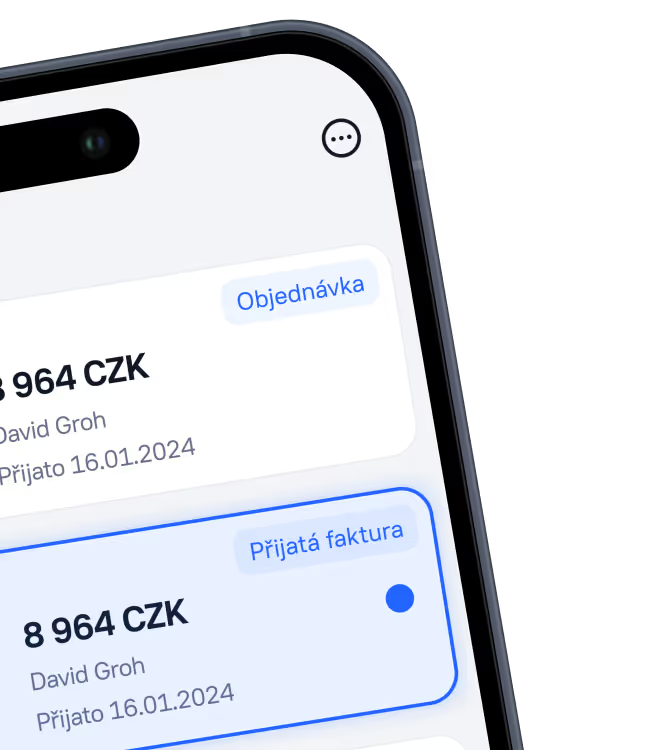
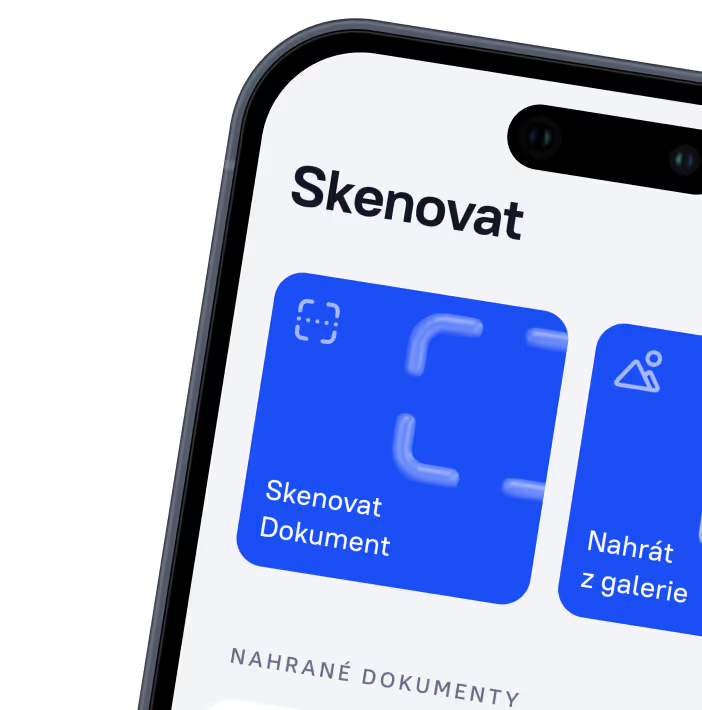
Approve expenses, upload documents and keep track of costs in real time, directly from your mobile.