

Timotej Čech
I help companies design ERP systems, integrations, and financial processes that make sense not only from a technical perspective, but also for the people who use them every day. At Wflow, I connect the worlds of ERP, accounting, and business operations to create efficient processes that improve control, productivity, and visibility across financial operations.



Timotej Čech specializes in the implementation, management, and optimization of ERP systems and their integration with other business tools. He helps organizations design processes where technology becomes a practical enabler rather than an obstacle for accounting and finance teams.
His work combines expertise in ERP systems, accounting, and business process management. He focuses on ensuring that systems work in real-life operations, support automation, and help companies manage documents, approvals, and financial data more effectively.
Before joining Wflow, Timotej worked as an ERP Manager & Integration Analyst, where he participated in ERP implementations, optimizations, and system integrations across various industries. This experience gives him a strong understanding of both the technical side of enterprise systems and the practical needs of teams working with them every day.
Key Experience & Projects
- ERP implementation and optimization projects
- Integration of ERP systems with business applications
- Process design for accounting and finance teams
- Analysis and optimization of business workflows
- Bridging technical solutions with business requirements
- Collaboration with accounting, finance, and IT teams
- Supporting companies in automation and digital transformation initiatives
Areas of Expertise
ERP Systems & Integrations
- ERP implementation and administration
- Designing integrations between accounting, finance, and business systems
- Optimizing data flows across platforms
- Connecting ERP systems with accounting processes and workflows
Financial Processes & Workflows
- Designing approval workflows
- Digitizing accounting document processes
- Simplifying operations for accounting and finance teams
- Increasing transparency and control over financial processes
Process Optimization
- Analysis of existing business systems
- Identifying process bottlenecks and inefficiencies
- Designing more efficient workflows
- Managing organizational change during transformation projects
Implementation & Professional Services
- Leading customer implementation projects
- Configuring systems according to client requirements
- Coordinating communication between customers, business teams, and technical specialists
- Supporting user adoption of new digital processes
Published articles
.avif)
E-Invoicing Without the Pain: Why You Do Not Need to Replace Your ERP
Companies are often concerned about e-invoicing not because of the invoices themselves, but because of everything that happens around them. Where will e-invoices arrive? How will they connect to the ERP? Who will approve them, and what will happen to exceptions?
Where will e-invoices arrive? Who will check them? How will they connect to the ERP? And what happens to invoices that do not match?
Most importantly: Who will reassure the accounting team that “it will be simple” while one of the company’s most sensitive processes is changing?
This is where the difference emerges between a company that introduces e-invoicing as another isolated project and one that already has its invoices under control through an accounting digitalisation and automation platform.
When documents already pass through a digital workflow, with clearly defined approvals, an audit trail, ERP integration and predefined rules, e-invoicing is not a revolution. It is simply a new type of input into an existing process.
Wflow helps companies prepare their accounting processes so that e-invoicing does not create chaos, but instead delivers cleaner data, less manual work and faster processing.
The First Step Towards E-Invoicing: A Workflow That Works
E-invoicing will become a problem in companies where nobody currently knows exactly what happens to an invoice between receipt and posting.
When invoices arrive through different channels, are approved by email, exceptions are resolved over the phone and the ERP is only the final destination of the document, e-invoicing alone will not solve the problem.
It will simply provide a more structured input into a process that was already out of control.
That is why some companies see e-invoicing as a threat.
What Changes When a Company Uses Wflow
In Wflow, every document has its place from the very beginning. It passes through an approval workflow, has clearly assigned responsible people, accounting context, a complete change history and a connection to the ERP.
When the way an invoice enters the company changes, the entire subsequent process does not need to be rebuilt.
That is the key point.
E-invoicing itself primarily ensures that an invoice arrives as structured data. But the real value comes afterwards—when those data are automatically incorporated into validation, approvals, accounting, archiving and the audit trail.
Companies already using Wflow are therefore not starting from scratch. They have a prepared process into which e-invoices can be incorporated naturally.
Instead of asking:
What will we have to change? they can focus on a more useful question:
Which manual steps will this finally eliminate?
.avif)
Why You Do Not Need to Replace Your ERP Because of E-Invoicing
One of the most common concerns is:
Will we need to replace our ERP because of e-invoicing?
In most cases, no.
The ERP can remain in place and continue to perform its main role in accounting, record-keeping and reporting.
Wflow acts as a process layer above the existing accounting or ERP system. It manages what happens before the invoice is posted:
- document receipt,
- verification,
- approval,
- validation,
- audit trail,
- secure digital archiving,
- and the transfer of data into accounting.
The goal is not to remove the ERP.
The goal is to eliminate manual work between the invoice, its approval and the accounting system.
That is an important distinction.
Many companies still imagine finance modernisation as a major replacement of their accounting software. But the biggest problem often does not lie within the ERP itself. It lies in everything that happens before the data reach it.
This is where companies encounter:
- delays,
- errors,
- missing approvals,
- and unnecessary searches for documents and information.
Peppol Handles Data Transmission. Wflow Handles What Happens Next
E-invoicing infrastructure such as Peppol helps ensure that a structured invoice is transmitted securely from the supplier to the customer.
But that is not the end of the process.
The invoice may arrive as data, but the company still needs to know what should happen to it next. Who approves it? Who checks it against the purchase order? Does it relate to an existing contract? Who handles an exception? Where can the history of decisions be found?
Peppol handles how the invoice arrives. Wflow handles what happens to it afterwards.
This is where the greatest value for companies is created. Not in receiving the e-invoice itself, but in ensuring that it does not become just another item waiting for manual review.
In Wflow, an e-invoice can continue through the process automatically: into validation, approval, accounting, archiving and the audit trail.
What About Other E-Invoicing Formats?
Across Europe, companies may encounter different national or industry-specific e-invoicing formats. But this does not change the main principle: the invoice format itself is not the final goal.
Whether a company works with PDF invoices, national structured formats or e-invoices exchanged through Peppol, it still needs to manage what happens to the document inside the organisation.
The format helps with the data. The workflow determines whether those data actually become a faster and more reliable accounting process.
That is why e-invoicing should not be viewed only as a legislative or technical change. It is also an opportunity to prepare finance teams to work with structured data.
Different national formats reflect today’s reality in individual markets. Peppol and EU-wide e-invoicing initiatives show the direction in which invoice processing is moving.
How to Implement E-Invoicing With Minimal Operational Change
Introducing e-invoicing does not have to begin with a major system overhaul. On the contrary, the safest approach is gradual implementation.
The company first identifies how invoices actually move through the business today, where the most manual work occurs and which steps are repeated again and again.
Typical examples include:
- re-entering invoice data,
- approvals by email,
- matching invoices with purchase orders,
- supplier checks,
- and searching for the history of previous decisions.
Once this is clear, it makes sense to connect the existing ERP to a process layer in which documents are managed before posting.
In Wflow, companies can configure workflows, roles, rules, approval limits and accounting context so that invoices do not begin accumulating uncontrollably in a new channel.
Only afterwards should the company expand the number of suppliers, invoice types or teams involved.
This allows the business to verify the process, define the rules and help employees become familiar with the new way invoices enter the organisation without disrupting the entire accounting operation.
When E-Invoicing Becomes a Real Benefit
E-invoicing is not a benefit in itself. The real benefit comes when structured data move through the company without manual re-entry, searching or approvals by email.
In a well-designed process, the invoice arrives as data, the system assigns it to the correct workflow, adds the necessary accounting context, sends it to the right approvers and preserves a complete history of every step.
The accounting team no longer needs to routinely re-enter, forward and verify every detail from the beginning. Instead, it can focus on exceptions, discrepancies and control.
For finance teams, this means cleaner data, faster approvals, less dependency on individual employees and better audit readiness.
For the company as a whole, it means less friction between suppliers, accounting, management and operations.
From this perspective, e-invoicing does not become an obligation that companies simply need to survive.
It becomes an opportunity to improve a process that already consumes too much time.
Would You Like to See How E-Invoicing Could Work in Your Company Without Replacing Your ERP?
Book a Wflow demo and identify where automation can remove manual work from your accounting process.
FAQ
Do We Need to Replace Our ERP Because of E-Invoicing?
In most cases, no. Wflow acts as a process layer above the existing accounting or ERP system and helps manage what happens before posting: document receipt, verification, approval, the audit trail and the transfer of data into accounting.
What Does Peppol Handle, and What Does Wflow Handle?
Peppol handles the transmission of structured invoices between suppliers and customers. Wflow handles the subsequent internal process: verification, approval, validation, accounting context, archiving, the audit trail and ERP integration.
What Is the Difference Between National E-Invoicing Formats and Peppol?
National e-invoicing formats define how structured invoices are created or processed in individual markets. Peppol is an international infrastructure for the secure exchange of structured electronic documents between companies and systems.
For finance teams, the key point is that structured data must be connected to internal workflows, approvals and accounting.
Why Is E-Invoicing Alone Not Enough?
E-invoicing ensures that an invoice arrives as structured data. The company still needs to manage who approves it, how it is checked, how exceptions are handled and how the information is transferred into accounting.
How Does Wflow Support E-Invoicing?
Wflow connects incoming documents, approval workflows, accounting rules, the audit trail, the archive and the ERP. This means an e-invoice does not become another isolated input, but part of an automated accounting process.
Can E-Invoicing Be Introduced Gradually?
Yes. A practical approach is to begin with selected invoice types, suppliers or parts of the process where the most manual work currently occurs. Once the workflow has been verified, the scope can be expanded gradually.
%20(1).webp)
What Is Peppol? Why Europe Is Moving from Documents to Data
European finance is gradually moving from documents to structured data, and Peppol is the infrastructure making that transition possible. Learn how electronic invoices are exchanged, why the EU is introducing new reporting requirements, and what companies should do to prepare.
For decades, companies have exchanged invoices as documents.
Sometimes they were printed on paper. Later they became PDF attachments sent by email. Although digital, they still required someone—or something—to read, validate, and manually process the information.
That model is gradually disappearing.
Across Europe, invoices are becoming structured business data that accounting systems can exchange automatically, securely, and almost instantly.
This transformation is driven by two major developments:
- the European Union's VAT in the Digital Age (ViDA) initiative,
- and the growing adoption of Peppol, the international network for exchanging structured electronic documents.
For finance leaders, this isn't simply another compliance requirement. It represents a fundamental shift in how financial information moves through an organization—and how quickly businesses can make decisions based on it.
In this guide you'll learn:
- why Europe is moving toward structured e-invoicing,
- what Peppol actually is,
- how invoice exchange works in practice,
- how the legislation differs across European countries,
- and why companies should prepare before new requirements become mandatory.
Why the EU Is Introducing Mandatory E-Invoicing
The European Commission isn't trying to change how companies run their internal accounting.
Its objective is much simpler:
to improve the quality and availability of VAT data across Europe.
Today, tax authorities often receive transaction information weeks—or even months—after an invoice has been issued. That delay creates opportunities for reporting errors, VAT fraud, and inefficient tax administration.
The European Commission refers to this difference between expected and collected VAT revenue as the VAT Gap.
To reduce it, the EU introduced the VAT in the Digital Age (ViDA) initiative, a long-term legislative framework that gradually introduces:
- digital VAT reporting,
- structured electronic invoices,
- standardized data exchange,
- and near real-time transaction reporting.
Rather than receiving static documents long after a transaction occurs, tax authorities—and businesses themselves—will increasingly work with structured financial data available almost immediately.
Key changes introduced by ViDA
- Digital Reporting Requirements (DRR)
- Structured electronic invoices
- Standardized invoice formats
- Faster VAT reporting across EU member states
- Greater interoperability between accounting systems
For CFOs, this is more than a regulatory change.
The same structured data that supports tax reporting also enables:
- real-time financial reporting,
- more accurate cash flow forecasting,
- faster month-end closing,
- and better strategic decision-making.
What Is Peppol?
Peppol Is Not Accounting Software
Peppol (Pan-European Public Procurement Online) is often mistaken for invoicing software.
It isn't.
Think of Peppol as a secure international delivery network that allows accounting systems, ERP platforms, suppliers, customers, and public authorities to exchange structured business documents using common technical standards.
Instead of emailing PDFs, systems exchange structured invoice data directly.
This means:
- invoices always reach the correct recipient,
- information follows standardized formats,
- transmission is secure,
- every transaction is fully traceable.
The important difference is that Peppol exchanges data—not documents.
When a PDF invoice arrives by email, someone still has to extract the information before accounting can begin.
With Peppol, accounting systems receive structured invoice data immediately, allowing much of the processing to happen automatically.
What is Peppol?
Peppol is an international network that enables the secure exchange of structured electronic invoices and other business documents between organizations. Instead of sending PDF files by email, companies exchange standardized financial data directly between their accounting systems.
How Peppol Works
One of Peppol's greatest advantages is that companies no longer need individual integrations with every trading partner.
Instead, the network operates using a four-corner model.
The sender submits an invoice through its certified Peppol Access Point.
The Access Point securely validates and delivers the structured invoice to the recipient's Access Point, which forwards it directly into the recipient's ERP or accounting system.
The entire process happens:
- without email,
- without PDF attachments,
- without manual uploads,
- without retyping invoice information.
Unlike traditional email communication, delivery through the Peppol network is monitored, traceable, and reliable.
For businesses exchanging thousands of invoices each month, this dramatically reduces administrative work while improving accuracy and security.
E-Invoicing Across Europe
Although the direction is common across Europe, implementation timelines differ between member states.
Some countries, including Italy, Germany, France, and Belgium, have already introduced mandatory electronic invoicing for parts of the private sector or are rolling it out in phases.
Others are still preparing national legislation as part of the broader ViDA framework.
What remains consistent across Europe is the long-term direction:
- structured electronic invoices,
- standardized data formats,
- automated reporting,
- and increasing interoperability between business systems.
For companies operating internationally, preparing early is often far less expensive than reacting once customers, suppliers, or regulators require compliance.
Why Peppol Matters for CFOs
For many finance teams, the biggest challenge isn't the invoice itself—it's the delay between when a transaction happens and when reliable financial data becomes available.
Invoices arrive by email, are forwarded for approval, manually entered into accounting systems, and only become visible in reports days or weeks later.
That delay affects much more than accounting.
It slows cash flow visibility, postpones decision-making, and limits the ability to manage working capital proactively.
Peppol helps remove that delay by enabling structured invoice data to flow directly between business systems.
For CFOs, this creates several immediate benefits:
- invoices reach recipients instantly,
- structured validation reduces processing errors,
- standardized data improves reporting quality,
- accounting teams spend less time on manual administration,
- financial information becomes available much earlier.
The result isn't simply faster invoice processing.
It's a finance function that operates with real-time visibility instead of historical information.
The Biggest Mistake Companies Can Make
Many organizations assume they can postpone preparations until electronic invoicing becomes legally mandatory.
In practice, that's often the most expensive approach.
By the time legislation takes effect, companies are forced to implement new processes under time pressure while simultaneously meeting regulatory deadlines.
Organizations that prepare earlier have time to:
- map existing invoice processes,
- identify manual bottlenecks,
- improve supplier and customer master data,
- standardize approval workflows,
- evaluate integration requirements,
- choose technology that supports future legislative changes.
Implementing Peppol isn't primarily an IT project.
It's an opportunity to modernize financial processes before external pressure makes those changes unavoidable.
Peppol Is Only One Part of the Process
Peppol solves one important problem:
how structured invoice data moves between organizations.
It does not manage what happens after the invoice arrives.
For example, Peppol doesn't handle:
- invoice approval workflows,
- document validation,
- expense management,
- ERP integration,
- accounting automation,
- document archiving,
- audit trails.
These processes remain the responsibility of the receiving organization.
That's why most companies combine Peppol connectivity with accounting automation platforms that manage the complete invoice lifecycle—from receipt to approval, accounting, and long-term storage.
From Invoice Delivery to Intelligent Finance Operations
Modern finance teams no longer view invoice processing as an isolated administrative task.
Instead, invoices become the starting point of a connected digital workflow.
A typical automated process looks like this:
- A supplier sends a structured invoice through the Peppol network.
- The invoice is automatically received.
- AI extracts and validates invoice information where additional processing is required.
- Approval workflows route the invoice to the appropriate people.
- The document is matched with purchase orders or contracts.
- Approved data is transferred into the ERP or accounting system.
- The invoice is securely archived together with its complete audit trail.
Instead of several disconnected systems and manual interventions, companies manage the entire lifecycle through a single digital process.
Where Wflow Fits
Peppol provides the infrastructure for exchanging structured invoice data.
Wflow extends that infrastructure by automating everything that happens after the invoice enters your organization.
Instead of treating invoices as isolated files, Wflow manages the complete document lifecycle.
Using a single platform, organizations can:
- automatically receive invoices from multiple channels,
- process structured Peppol invoices alongside PDFs and scanned documents,
- apply AI-powered data extraction,
- automate approval workflows,
- integrate directly with ERP and accounting systems,
- maintain secure digital archives with complete audit trails.
This allows finance teams to benefit from Peppol without changing the way employees collaborate internally.
As legislation evolves across Europe, organizations already using automated financial workflows will be significantly better prepared for future compliance requirements.
Preparing Your Organization
Moving to structured electronic invoicing shouldn't begin with software selection.
It should begin with understanding your current financial processes.
A practical implementation roadmap typically includes:
1. Review your current invoice process
Identify how invoices enter your organization, where manual work occurs, and which systems are involved.
2. Evaluate your data quality
Structured invoicing depends on accurate supplier information, customer master data, and standardized processes.
3. Standardize approval workflows
Clearly defined approval rules make automation significantly easier.
4. Choose technology that supports future legislation
Look beyond today's requirements.
Choose solutions that already support structured invoices, ERP integrations, digital archiving, and future reporting obligations.
5. Prepare your suppliers
Successful digital invoicing depends on both sides being ready to exchange structured data.
Ready for the Next Stage of Digital Finance?
Electronic invoicing is only the first step.
Discover how Wflow combines Peppol connectivity, AI-powered invoice processing, approval workflows, ERP integrations, and digital archiving into one platform designed for modern finance teams.
Glossary: Peppol, ViDA and E-Invoicing
A
Access Point
A certified gateway to the Peppol network. Instead of sending invoices directly to customers or suppliers, organizations exchange documents through certified Access Points that securely deliver structured data between accounting systems.
D
Digital Reporting Requirements (DRR)
Digital Reporting Requirements are part of the European Commission's VAT in the Digital Age (ViDA) initiative. They define how businesses will report VAT-related transaction data electronically to tax authorities, replacing delayed or periodic reporting with standardized digital data exchange.
E
Electronic Invoice (E-Invoice)
An electronic invoice is not a PDF attached to an email.
A true e-invoice consists of structured data that accounting and ERP systems can automatically receive, validate, and process without manual data entry.
The invoice becomes machine-readable rather than document-readable.
P
PDF Invoice
A PDF invoice is a digital document designed primarily for people.
Although it replaces paper, accounting systems still need OCR or manual processing before the information can be used.
A structured electronic invoice eliminates this extra step.
Peppol
Peppol (Pan-European Public Procurement Online) is an international network for exchanging structured electronic business documents.
It defines how systems communicate, not how companies perform accounting.
Think of Peppol as the internet for electronic business documents.
Email delivers files.
Peppol delivers structured financial data.
S
Structured Electronic Invoice
A structured invoice stores every invoice element—supplier, VAT number, invoice amount, payment terms, tax information—as standardized machine-readable data.
Because accounting systems understand the structure, invoices can be processed automatically without manual intervention.
V
VAT Gap
The VAT Gap measures the difference between the VAT revenue governments should theoretically collect and the amount they actually receive.
Reducing this gap is one of the main reasons why the European Union promotes digital reporting and structured electronic invoicing.
VAT in the Digital Age (ViDA)
VAT in the Digital Age (ViDA) is the European Commission's initiative to modernize VAT reporting across the European Union.
Its long-term objective is to replace fragmented national approaches with standardized digital reporting and structured electronic invoicing, allowing businesses and tax authorities to work with financial information in near real time.
Frequently Asked Questions
What is Peppol?
Peppol is an international network that enables organizations to exchange structured electronic invoices and other business documents securely between accounting systems, ERP platforms, suppliers, customers, and public authorities.
Is Peppol mandatory?
Peppol itself is not mandatory across the entire European Union.
However, many European countries already require structured electronic invoicing for specific transactions—particularly in the public sector—and several member states are introducing mandatory B2B e-invoicing as part of their implementation of the ViDA framework.
Businesses should always verify the current requirements in the countries where they operate.
Do I need to replace my ERP system?
Usually not.
Most organizations can continue using their existing ERP or accounting software by integrating it with a Peppol Access Point or an accounting automation platform that supports structured electronic invoicing.
Is sending a PDF invoice by email considered e-invoicing?
No.
A PDF remains a document intended for human reading.
True electronic invoicing means exchanging structured invoice data that accounting systems can process automatically without manual intervention.
What's the difference between Peppol and accounting automation?
Peppol manages the secure exchange of structured invoice data between organizations.
Accounting automation platforms manage everything that happens after the invoice arrives, including approval workflows, AI-powered data extraction, ERP integration, accounting processes, reporting, and digital archiving.
The two technologies complement each other.
Sources
- European Commission — VAT in the Digital Age (ViDA)
- OpenPeppol — Official Peppol Documentation
- European Commission — Electronic Invoicing Standard (EN 16931)
- Deloitte — Finding the Business Benefits in the E-Invoicing Transition
- CEN (European Committee for Standardization) — EN 16931 Electronic Invoicing Standard
More than 8,000 companies already manage finances without chaos.





%25201.jpeg)
.jpeg)



Lindt values low error rates and significant time savings
“The Wflow mobile app is the simplest and fastest way to approve invoices. I especially appreciate that I don’t need to turn on my computer for every transaction—just a few taps in the app and everything is taken care of.”


Shoptet introduced its first AI-powered internal processes with Wflow
“Today, we process all incoming documents digitally—from approval to handover to our external accounting firm. Wflow helped us streamline the entire process, improve efficiency, and build a strong foundation for further automation.”





.avif)





How to get your finances under control
Practical instructions on how to speed up document processing, set up approvals, and get real-time cost insights.
.webp)

.avif)
Accounting on Autopilot: AI Takes Over Routine Document Processing
Wflow Accounting Autopilot is an AI layer that automates routine document work from receipt through to preparation for accounting. It collects and classifies documents, extracts data, checks inconsistencies and shows where accountant intervention is required. The goal is not to replace the accounting team, but to remove manual work and shift attention towards control, exceptions and financial management.
Wflow Accounting Autopilot is an AI layer for automating routine document processing.
It automatically collects, classifies, reads and checks documents, prepares them for accounting and highlights where accounting expertise is needed.
Accountants step in mainly where experience, control or decision-making is required.
For modern companies, this shift matters for a simple reason: the volume of documents, data and control requirements is growing faster than the capacity of finance teams.
If accounting is expected to support business management rather than merely process administration retrospectively, routine work needs to move from accountants’ desks into automated workflows.
What Accounting Autopilot Does
Accounting Autopilot covers the document journey from receipt through to preparation for accounting.
After receiving a document, it recognises and classifies it, extracts data, checks their accuracy, flags inconsistencies and prepares an accounting entry.
The document is then ready to be sent to the ERP or accounting system.
Why Accounting Autopilot Exists and Who It Is For
Accounting routine needs to be automated not because it is unimportant, but because it unnecessarily consumes the time of people who should be creating greater value for the company.
Accounting Autopilot is being developed because data extraction alone is no longer enough.
An invoice should not end as a completed set of fields that accountants still need to process manually.
It should move through the whole process: from receipt through checks and accounting suggestions to a clear signal showing whether it can continue automatically or requires human expertise.
A single simple document can involve several manual steps today: finding it in an inbox or folder, identifying who it belongs to, retyping information, adding an account, cost centre or project, checking it and passing it on.
For one document, this may seem minor.
Across hundreds or thousands of documents every month, those small steps become a significant process burden.
Accounting Autopilot gradually reduces that burden.
Standard documents move through the process almost independently, while accountants step in where their experience actually adds value: exceptions, ambiguity, inconsistencies or sensitive cases.
How Accounting Autopilot Works
Accounting Autopilot is built around five main functions: Smart Inbox, Data Extraction, Dynamic Accounting, Validation and Control, and the Traffic Light.
Together, these functions cover the entire document lifecycle from receipt to the decision on whether it can continue automatically.
1. Smart Inbox Classifies All Incoming Documents
Smart Inbox automatically collects incoming documents, recognises their type and assigns them to the correct client or folder.
Invoices, receipts, contracts and emails no longer remain scattered across different inboxes, folders and attachments.
The aim is for accountants not to begin their day sorting through incoming mail and searching for what arrived.
Documents are ready for processing immediately after receipt.
2. Data Extraction Ends Manual Re-Keying
Data Extraction automatically reads important information from invoices and documents: amounts, VAT, suppliers, due dates and other fields.
Accountants only check the extracted information and correct it if necessary.
Feedback matters as well.
When an accountant corrects a value, the system learns from that correction for similar documents in the future.
A correction therefore becomes more than a one-off task.
It becomes an investment in the accuracy of future processing.
3. Dynamic Accounting Suggests the Accounting Entry
Dynamic Accounting pre-fills the account, cost centre or project based on how the company processed similar documents in the past.
The Autopilot therefore does not rely only on a universal rule.
It learns from the real history and habits of the specific company.
For a known supplier, the system can immediately suggest the usual accounting treatment.
Recurring cases are processed more consistently, and new team members can understand the company’s usual accounting practice faster.
4. Validation and Control Find Errors Before They Become Problems
Validation checks for inconsistencies before posting.
It runs in the background and only requires accountant attention when the process reaches step 5.
It can flag:
- a duplicate invoice,
- an unusual amount,
- a change in the bank account of a known supplier,
- or another pattern that deviates from normal operations.
5. The Traffic Light Shows Where Human Attention Is Needed
The Traffic Light is the final stage of the control layer.
For each document, it shows how confident AI is about the individual steps and what should happen next.
A green document can continue automatically.
An amber document needs only a quick check.
A red document means something does not fit and the document requires accountant review.
This means the team does not need to check everything with the same intensity.
It can focus attention where it is genuinely needed.
The Traffic Light separates documents that can continue automatically from cases where accountant involvement has real impact.
Routine invoices do not need to wait for manual review.
But a changed supplier bank account, an unusual amount, incorrect VAT treatment or a recurring error for a particular client is sent directly to a person.
Accountants therefore no longer deal only with whether “the document is correct”.
They can actively help the business: flag a risky supplier, identify duplicate or suspicious invoices, standardise accounting across the team, accelerate month-end preparation, explain unusual expenditure to management or suggest better rules for the future.
That is no longer document re-keying.
That is financial control.
What Wflow Accounting Autopilot Brings to Companies
Accounting Autopilot has clear goals:
- reduce the cost of document processing,
- increase team capacity without additional hiring,
- accelerate closing and reporting,
- reduce errors,
- and give finance teams more time for management rather than operations.
For accounting firms, this means the ability to serve more clients with the same team and improve margins.
For small companies, less administration and better financial control.
For mid-sized companies, the ability to grow without routine work increasing at the same pace.
For large and international companies, greater standardisation, better data-quality control and scalable finance operations without adding further complexity.
This is therefore not only about faster document processing.
It is about increasing the capacity of the finance team.
Routine work shrinks while the space for control, exceptions, financial management and decision-making grows.
Control Remains With Accountants
Accounting Autopilot is not built on the idea that AI should be given free rein.
Quite the opposite.
Its principle is that AI prepares suggestions and people make the decisions.
Every record should remain auditable.
Accountants can see what AI did and why.
AI learns from the specific company’s data, while sensitive or disputed cases are automatically routed for review.
For every suggestion, it should be possible to trace what the AI based it on.
This matters because accounting is not merely an administrative process.
It has legal, tax and financial consequences.
Accounting Autopilot is therefore not designed to automate responsibility.
It is designed to automate the routine work that prevents accountants from focusing on responsible work.
How the Rollout Will Work
Wflow Accounting Autopilot is being rolled out gradually.
Each new function is intended to take over another part of manual work without forcing companies to redesign their existing processes or make one major change at once.
Right now, we are improving data extraction using Wflow AI, and Smart Inbox will launch in autumn 2026.
Further stages will follow over the coming months.
There is a practical reason for the gradual rollout.
Companies do not introduce AI into every step at once.
They gradually learn what the system can do, where it provides the greatest benefit and where human control should remain.
FAQ
What Is Accounting Autopilot?
Accounting Autopilot is an AI layer in Wflow that automates routine document processing from receipt through to preparation for accounting.
It classifies, reads and checks documents, suggests accounting entries and shows where accountant intervention is required.
Does Accounting Autopilot Replace the Accounting System?
No.
Wflow does not replace your accounting system.
It works as an AI layer above the existing accounting or ERP system and prepares documents so they can continue to be processed in the environment you already use.
Who Keeps Control of the Decision?
Control remains with the accounting team.
AI prepares suggestions, but the final decision remains with a person.
Sensitive or disputed cases are automatically routed for review.
Want to find out how much routine work Accounting Autopilot could take over in your accounting process?
Book a Wflow demo and see how AI can prepare documents, check exceptions and keep the final decision in your hands.
%20(1).avif)
Don’t Try to Automate Responsibility
Safe use of AI in accounting must be built around human oversight, traceability and a clear boundary between what the system can prepare and what an accountant needs to confirm.
AI in accounting can perform a great deal of work faster than a person. It can read a document, complete data fields, suggest accounting treatment, flag inconsistencies or prepare information for review.
All of that makes sense to automate.
But for a cautious accountant, the question “How much time will AI save me?” is immediately followed by another:
“If AI gets something wrong, who is responsible?”
Because responsibility is not simply another item in a workflow.
And this is where the most important discussion about AI in accounting begins.
The question is not only what the system is capable of doing. It is where automation should stop and where human judgement becomes essential.
AI Can Suggest. It Cannot Carry the Consequences.
Accounting is not only the technical processing of documents.
Every accounting decision can have tax, legal, financial or client consequences.
An incorrect VAT treatment, a missed exception or a document interpreted in the wrong way is not simply a system error.
It is a decision somebody ultimately needs to be able to justify.
That is why AI in accounting should not be designed as a replacement for responsibility.
A system can prepare a suggestion, but the accountant needs to know when to confirm it, when to modify it and when to stop the process.
Why the Final Decision Must Remain Human
When AI suggests accounting treatment, it can draw on:
- company history,
- similar documents,
- the supplier,
- the amount,
- email context,
- or existing accounting rules.
That is extremely useful because the accountant no longer needs to start with an empty field.
But a suggestion is not the same as a decision.
The accountant understands the company’s context, internal practice, unusual situations, exceptions and wider implications.
They know when two invoices are genuinely similar — and when they merely look similar.
That difference is exactly where responsibility sits, and it cannot simply be handed over to a system.
Traceability Is the Foundation of Trust
In accounting, it is not enough for a system to make a suggestion.
The accountant needs to see why it made that suggestion.
If AI recommends an account, cost centre or VAT treatment, or flags an inconsistency, it should be possible to trace the reasoning back to its source.
Was it based on historical accounting behaviour? A rule? A previous correction? A specific company practice?
Without an audit trail, an AI suggestion can easily become a black box.
And black boxes do not belong in accounting.
Trust in AI does not come from a system appearing intelligent.
It comes from the accountant being able to quickly verify why a particular course of action was suggested — and decide whether it makes sense.
The Traffic Light as the Boundary Between Automation and Responsibility
One of the most important elements of Wflow Accounting Autopilot is the Traffic Light.
Not because coloured labels look good in a process, but because they provide a clear boundary between where accounting automation can continue and where a person needs to step in.
The Traffic Light is not decoration.
It is a safeguard against automating errors.
It means accountants do not need to devote the same amount of attention to every document, while automation is prevented from continuing into situations that are no longer routine.
And responsibility stays exactly where it belongs.
Safe AI Needs to Understand the Accounting Environment
AI can be very good at understanding text and document structure.
In accounting, however, that is not enough.
There is no single European accounting and VAT practice that applies identically everywhere.
Companies operate under national accounting, VAT and reporting requirements while also dealing with cross-border EU transactions.
A common example is an invoice from another EU Member State.
It is not enough to identify the supplier, amount and due date.
The correct treatment may depend on the type of transaction, the VAT status of both parties, whether reverse charge applies and the reporting requirements in the relevant Member State.
At the same time, EU rules are moving towards greater digital convergence: ViDA introduces new digital reporting requirements for cross-border B2B transactions from July 2030, based on e-invoicing.
That is why it is not enough for AI to simply “understand invoices”.
It needs to understand the environment in which those invoices are processed.
For AI in accounting to be safe, its suggestions need to reflect the relevant accounting and tax context — and they must remain verifiable.
Not so accountants can stop thinking, but so they do not have to research ordinary recurring situations from scratch every time.
How Wflow Accounting Autopilot Is Built Around This Principle
Wflow Accounting Autopilot is being built on exactly this principle:
AI handles routine work, but the final decision remains with a person.
Wflow Accounting Autopilot is not a replacement for an accounting system. It works as an AI layer above it. It receives documents, classifies them, reads them, prepares and checks them, suggests the next step and passes processed data into the accounting or ERP system.
The goal is not to remove accountants from the process.
The goal is to remove work that consumes their time while preserving oversight, control and responsibility wherever they are necessary.
Accounting Autopilot will therefore not function as an independent “AI accountant”.
It will be part of the accounting workflow.
Standard cases will move faster, questionable cases will stop, and suggestions will show what they are based on.
For a broader look at which parts of accounting AI will take over first and why advisory work will become more valuable, read Accounting Routine Belongs to AI. Decision-Making Stays Human.
FAQ
Who Is Responsible When AI Suggests an Accounting Treatment?
Responsibility for the accounting decision remains with a person.
AI can prepare the suggestion, but an accountant must decide whether to accept, modify or reject it.
Can AI Post an Accounting Document Automatically?
For routine cases where the system has high confidence, AI can significantly accelerate preparation and automate recurring steps.
Sensitive, disputed or uncertain cases should be sent to the accounting team for review.
What Is the Traffic Light in Wflow Accounting Autopilot?
The Traffic Light indicates how confident AI is about a particular document.
Green cases can continue automatically, amber cases require quick verification, and red cases require accountant review.
Why Does AI in Accounting Need to Understand Local Practice?
Because accounting and taxation are not governed only by the logical structure of a document.
VAT treatment, domestic reporting rules and accounting practice differ between jurisdictions, while cross-border EU transactions introduce another layer of rules.
How Does This Relate to Wflow Accounting Autopilot?
Wflow Accounting Autopilot is based on the principle that AI takes over routine document work while final decisions remain with the accounting team.
AI suggests. People decide.
Want to see how AI can help with accounting routine without losing control over the outcome?
Book a Wflow demo and see how Accounting Autopilot can prepare documents, highlight exceptions and keep the final decision in your hands.
.avif)
Accounting Routine Belongs to AI. Decision-Making Stays Human.
AI in accounting is not meant to replace accountants. It is meant to take over the routine work that currently consumes time better spent on control, exceptions, advisory and decision-making. See which parts of accounting work AI is likely to automate first.
Finance teams have been hearing for years that AI will change accounting.
But a more practical question receives far less attention: what exactly should AI take over, and what should remain in the hands of accountants?
Finance teams already know that routine work consumes time, document volumes are increasing and manual processing will not remain sustainable indefinitely.
The most important change therefore lies in separating work into routine that can be handled by a system and decisions that must remain with people.
This distinction will determine whether AI genuinely helps a company or simply adds another layer of tools to an already complex process.
Accounting routine belongs to AI. Decision-making stays human.
AI Is Changing Accounting. But Not in the Way Companies Often Fear.
The most important question today is not whether AI will replace accountants.
It is why accountants should continue doing work manually when that work does not require their judgement.
Document classification, data extraction, accounting suggestions and checks of recurring cases increasingly belong with the system.
Responsibility, interpretation, exceptions and decisions should remain with accountants.
This is how accounting will change: not into work “before AI” and “after AI”, but into routine that can be delegated to technology and expert work where people remain indispensable.
Why Accounting Advisory Will Become More Valuable
When AI takes over routine work, the value of accountants does not decrease. It shifts.
Today, a large part of accounting work happens in operations that are necessary, but not always strategic.
The more routine work systems take over, the more visible it becomes who can work effectively with exceptions, data, clients and decision-making.
For accounting firms, this represents a fundamental change.
When most working time is consumed by manual document processing, it is difficult to scale services, increase margins or develop advisory work.
When routine processing falls significantly, however, an accounting team can serve more clients without costs increasing at the same rate.
The same applies to internal finance teams.
Less time spent on operations means more capacity for control, faster closing, more accurate reporting and more active financial management.
Advisory will become more valuable precisely because routine processing will become increasingly difficult to defend as the core value of accounting work.
Three Layers of Accounting Work AI Will Take Over First
The First Layer Is Document Collection and Classification
Documents arrive from many directions: email, cloud storage, mobile devices, suppliers, employees and clients.
Before an accountant can even start processing them, time is often already lost locating, sorting and checking whether they are actually accounting documents.
AI can take over this layer first because it is primarily about recognition and organisation, not professional judgement.
A document is captured, classified and prepared so that the accountant does not start by searching.
They start where their attention is actually needed.
The Second Layer Is Data Extraction and Accounting Suggestions
Amounts, VAT, suppliers, due dates, accounts, cost centres or projects are still frequently entered and checked manually.
AI can significantly reduce this type of work because it is repetitive, prone to typing errors and increasingly recognisable from a company’s historical behaviour.
The Third Layer Is Validation, Control and Exception Detection
Once AI understands normal operating patterns, it can become better at identifying what deviates from them.
Accountants no longer need to review every document with the same intensity.
They can focus on cases where something is inconsistent, incomplete or requires expert judgement.
What AI Will Not Take Over in Accounting
AI can prepare a suggestion.
It should not carry the final responsibility.
Accounting is not simply the technical processing of documents. It also involves evaluating context, exceptions, risks and the impact of a particular decision on a company or client.
The same type of document can mean something different in different situations.
That is precisely where the accountant’s value becomes visible.
The future of accounting is therefore not a future without accountants.
It is a future without unnecessary retyping, sorting and searching.
What This Means for Companies
Companies will not use AI in accounting simply because it is fashionable.
They will use it because without AI it will become increasingly difficult to manage growing volumes of documents, requirements, rules and exceptions with the same team.
- Small businesses can eliminate a significant share of administration and gain better financial visibility.
- Mid-sized companies can grow without routine work increasing at the same rate as document volumes.
- Large companies can achieve greater standardisation, stronger data-quality control and faster financial management instead of relying only on retrospective month-end information.
The point is therefore not simply cost reduction.
It is about capacity, control and the ability to make financial decisions based on current data.
How Wflow Accounting Autopilot Fits Into This Change
Wflow Accounting Autopilot is an upcoming AI layer designed to gradually take over routine parts of document processing.
It will not arrive as one major switch.
Automation will expand step by step: from data extraction and Smart Inbox through dynamic accounting suggestions and validation to a stage where standard documents can move through the process independently, with accountants involved primarily in exceptions.
The final layer, the Traffic Light, will indicate how confident AI is about each processing step and whether:
- the document can continue automatically,
- a quick confirmation is sufficient,
- or full accountant review is required.
Accounting Autopilot will therefore become part of the accounting workflow.
It will classify documents, extract their data, suggest accounting treatment based on company history, flag inconsistencies and use the Traffic Light to show where automation makes sense and where an accountant needs to step in.
Its purpose is not to remove accountants from the process.
It is to move their attention to where it creates the greatest value.
AI will handle routine work.
Accountants will decide on exceptions, control and final outcomes.
AI adoption will happen gradually.
Companies will not need to change their entire process at once. They will be able to delegate individual parts of routine work to AI step by step.
Simpler operational tasks first; more sophisticated control and exception handling later.
In other words:
AI will work. Accountants will decide.
Control Remains With Accountants
Giving AI the routine work does not mean losing control.
Good automation should strengthen control.
Every suggestion must remain traceable.
For each decision, accountants should be able to see what information AI used, what context it considered and why it suggested a particular result.
Sensitive, unclear or disputed cases should not disappear into automation.
They should instead reach the accounting team faster and in a clearer form.
Want to find out which parts of accounting routine AI could take over in your company?
Book a Wflow demo and see how accounting work can gradually move from manual document processing towards control, exceptions and decision-making.
FAQ
Will AI Replace Accountants?
AI will not replace accountants when it comes to responsibility, decision-making or advisory work.
It will primarily take over routine tasks such as document classification, data extraction, accounting suggestions and identifying recurring exceptions.
What Can AI Automate in Accounting?
AI can automate document collection and classification, data extraction, accounting suggestions, discrepancy checks, validation and the identification of cases requiring human attention.
What Must Remain in the Hands of Accountants?
Final responsibility, assessment of exceptions, disputed cases, interpretation of accounting data, client communication and advisory must remain with accountants.
How Will Wflow Accounting Autopilot Work?
Accounting Autopilot will gradually take over routine parts of document processing, from intake through to accounting suggestions.
The accounting team will primarily become involved where the system identifies an exception, uncertainty or a need for a decision.
Will Companies Be Able to Keep AI in Accounting Under Control?
Yes.
Wflow Accounting Autopilot is designed around transparency, auditability and human oversight.
For every suggestion, it should be possible to trace what AI did, why it did it and when accountant intervention is required.
When Does AI in Accounting Create the Greatest Value?
AI creates the greatest value where accounting teams repeatedly process large volumes of similar documents, manually enter data, review routine cases and consequently lack time for exceptions, control, reporting or advisory.
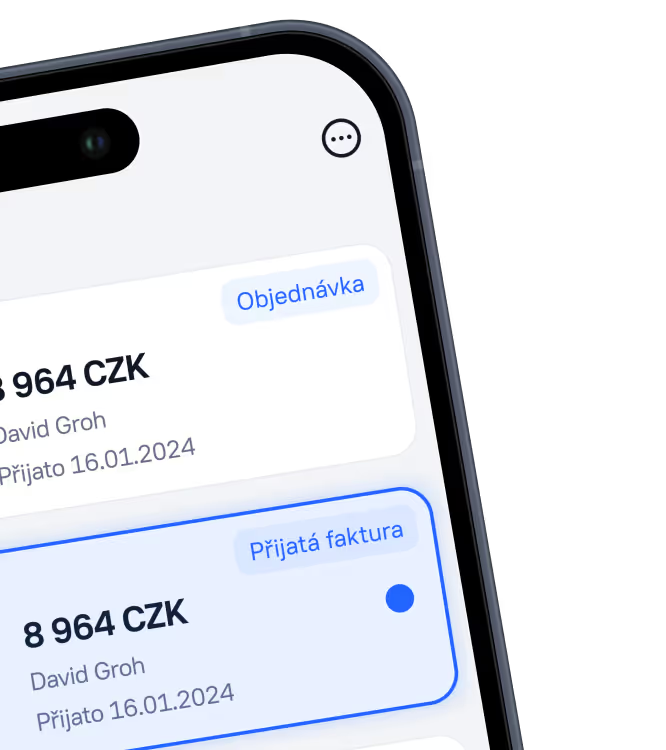
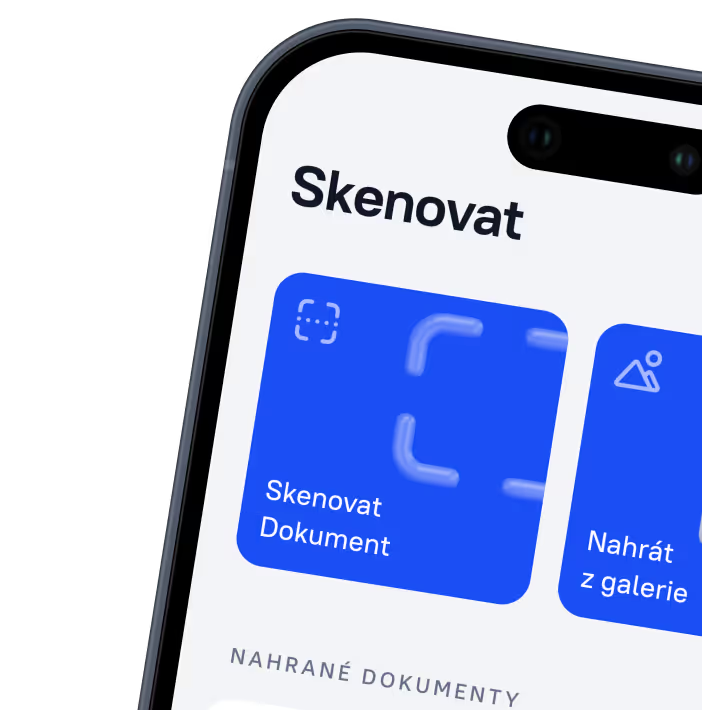
Approve expenses and manage documents anytime, anywhere
Approve expenses, upload documents and keep track of costs in real time, directly from your mobile.